

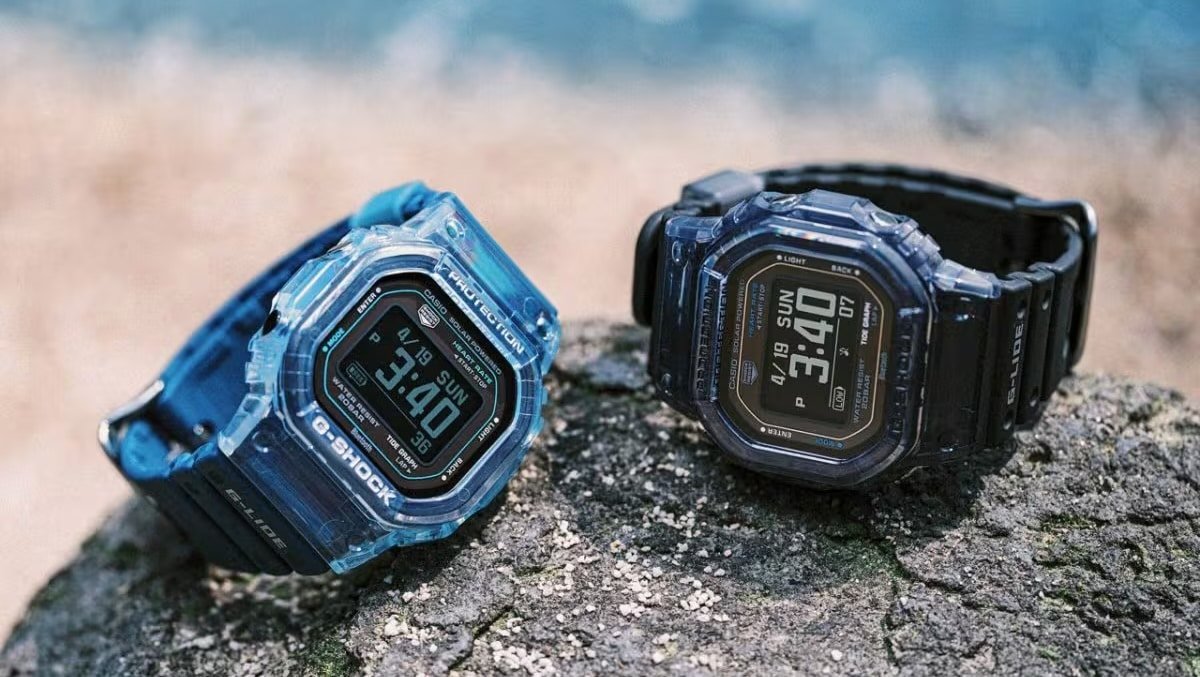
Casio has announced the G-SHOCK GBX-H5600, another Polar powered watch that brings heart rate tracking and fitness analysis into the G-LIDE surf lineup. It pairs the classic 5600-style square with tide data, a MIP display, USB charging and solar-assisted timekeeping, while extending the Polar-backed feature set seen on the DW-H5600.
This is the first G-LIDE model with an optical heart rate sensor, and it connects two strands of Casio’s lineup that have been running in parallel. The GBX-100 brought the surf features and MIP display. The DW-H5600 brought heart rate and Polar-backed training metrics. The GBX-H5600 is where those two meet.
A G-LIDE that now works off the beach
Up to now, G-LIDE has been very specific in what it does well. Tide graphs, moon data and ocean timing have always been the focus, with only light activity tracking in the background. That made sense for its audience, but it also limited how often the watch made it onto the wrist outside of surf sessions.
The GBX-H5600 changes that. It tracks heart rate, steps and workouts, and uses smartphone GPS to tighten up distance data. More importantly, it adds a layer of analysis that was missing before. Polar handles that side, with metrics like Running Index, Cardio Load, Energy Used and Nightly Recharge, along with sleep tracking and recovery insights.
That does not turn it into a full sports watch, but it does make the data more useful. You are not just logging activity anymore, you are getting context around effort and recovery. For a G-SHOCK, that is a noticeable shift.
Same square look, lighter feel
On the hardware side, Casio keeps things familiar. The case comes in at 51.1 by 44.5 by 17.3 millimetres and weighs 47 grams, which is lighter than earlier heart rate equipped squares. That matters because these watches are often worn all day, not just during workouts.
The Memory in Pixel display is also the right call here. It keeps visibility strong outdoors and fits the digital G-SHOCK identity much better than a brighter but more power-hungry screen would. You still get shock resistance, 20 bar water resistance and bio-based resin used across the case, bezel and band.
Battery trade-offs are still there
Casio goes with USB charging supported by solar assist. Solar helps keep the time display running when the battery is low, but the health tracking and connected features rely on regular charging. That is the same compromise seen on the DW-H5600.
Battery life lands at around 35 hours with activity tracking and about a month in basic watch mode with heart rate turned off. It is not aiming to compete with full solar G-SHOCKs here, but it does enough to balance features with battery size.
Our takeaway
Casio is clearly leaning into this whole Polar powered thing. Up to now, this was mostly sitting in watches like the DW-H5600 and the more sports focused GBD-H2000. Now that same layer is turning up in a G-LIDE, which is not where you would have expected it a year ago.
That is what makes this interesting. Casio is not trying to build its own big fitness platform, it is just plugging in Polar and dropping those insights into different watches. So now you have a surf watch that can actually tell you something useful about your training and recovery, not just show you tides and moon phases.
At the same time, they are not overdoing it. This is not suddenly trying to be a Garmin. There is no deep training ecosystem or standalone GPS. It just sits in that middle space, where you get enough data to be useful, but it still feels like a proper G-SHOCK you can wear anywhere without thinking about it.
Subscribe to our monthly newsletter! Check out our YouTube channel.
And of course, you can follow Gadgets & Wearables on Google News and add us as a preferred source to get our expert news, reviews, and opinion in your feeds.
