

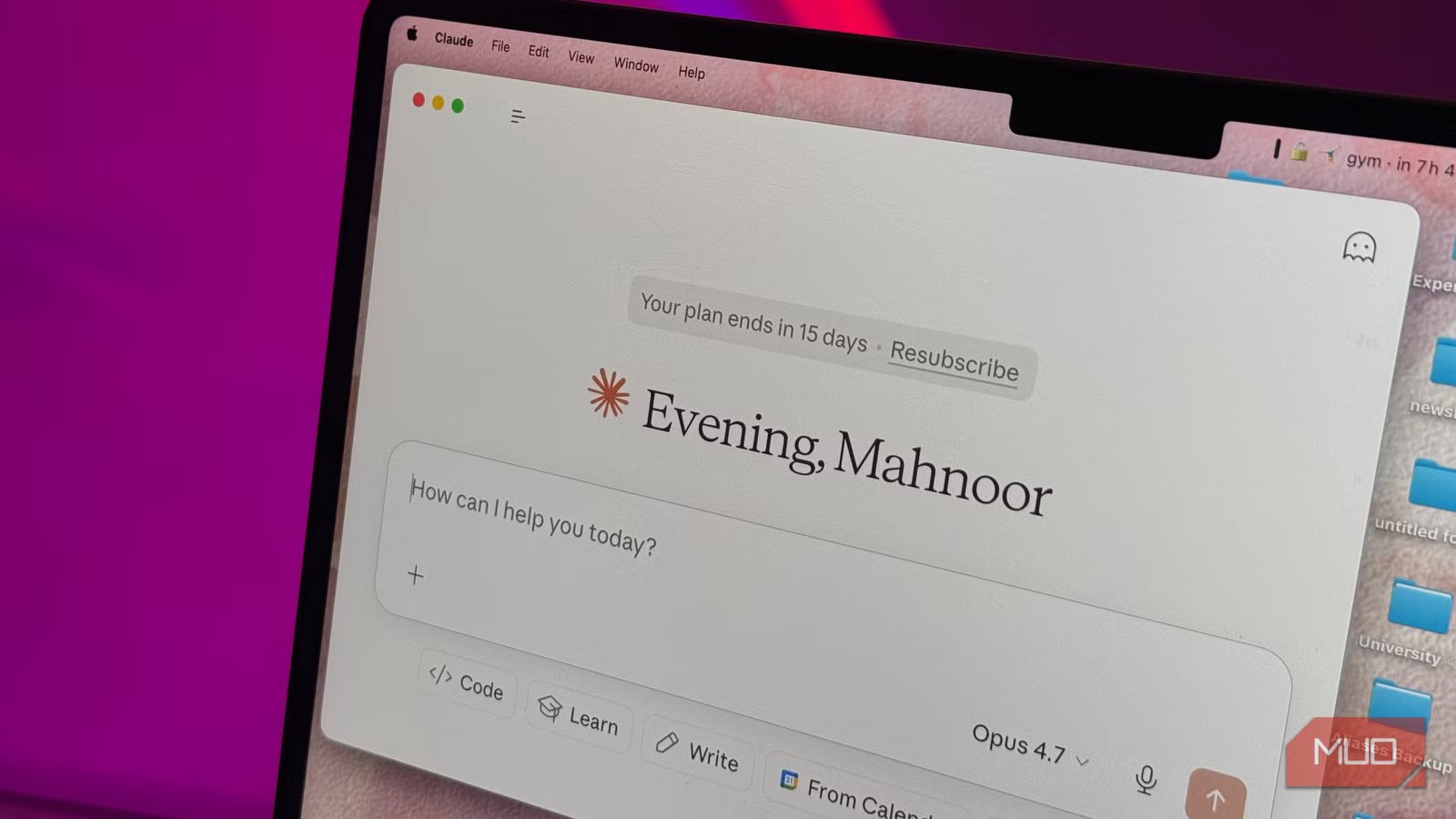
I don’t really need to begin this article with a classic introduction about why Claude is everyone and their mother’s go-to AI tool. It’s packed with features competitors don’t have, it’s constantly shipping something new (and spawning a fresh wave of “my job is in jeopardy” memes every other week), and it can be a genuine productivity powerhouse when used right.
A tool is only as good as you make it, though. The onus is on you to actually learn what it can do, push past the surface-level “write me an email quickly” use cases, and figure out which features fit into the way you actually work. Given how quickly Claude (and every other AI lab) is iterating, missing a feature launch isn’t exactly surprising. But interestingly, the feature I’m about to talk about isn’t some buried setting or recent launch you might’ve missed. It’s been sitting right there in the interface for a while now, and somehow it still flies under the radar for most people I talk to.
The problem with how most people use Claude
Yes, you’re doing it too
Amir Bohlooli / MUO
Most people head to their AI chatbot of choice, ask it a question, continue their conversation within the same chat until they’re done, and start a fresh one when they move on to something else. Now, there’s nothing wrong with this workflow, especially for one-off questions. If you don’t want to Google what the weather is like in Dubai in December, asking an AI chatbot and moving on with your life is a perfectly reasonable use of the tool.
The same goes for quick definitions, one-off emails, or generating a quick slide deck from a report you’ve already written. However, most of what people actually use Claude for isn’t a one-off. It’s the report you’re writing over three weeks, the codebase you’ve been working on for months, the course you’ve been taking the entire semester. No matter what type of AI user you are, there is likely some ongoing piece of work in your life that you keep coming back to Claude for. And every single time you start a new chat for it, you’re essentially starting from zero. You’re re-uploading the same files, re-explaining the same context, and constantly reminding Claude of the same preferences you’ve already laid out a dozen times before.
Now, you might think — hey, the memory feature within AI tools exists for this entire reason. And you’re not wrong, until you’re working on a project for work and the AI model keeps referencing the birthday party you were planning last weekend, or the recipe you asked about on Tuesday, or the fact that you mentioned once, in passing, that you’re trying to learn Spanish. Memory is great in theory. In practice, it blurs everything together into one pile of context that Claude pulls from whether you want it to or not.
Claude Projects lets you create dedicated workspaces for ongoing work
Everything in its right place
This is where Claude’s Projects feature comes in. A Project is essentially a dedicated workspace for one specific thing. This could be a workspace for all the work you do for one specific client, a course you’re taking, a project you’re working on — just anything that you know you’re constantly going to come back to. Inside that workspace, you can upload the files Claude needs to reference, set custom instructions for how you want it to behave, and start as many chats as you want.
Unlike a regular thread, chats within Projects all share the same underlying context that’s only specific to what that project is about. While it can continue to browse the web and use its training data, it won’t search through your other conversations in Claude and pull unrelated context from chats you’ve had outside the Project. What happens in the Project stays within the Project. And just as importantly, what happens outside the Project stays outside of it.
When you create a Project within Claude, you’ll be asked to give it a name and then describe the project and goals. You can then add instructions to tailor Claude’s responses, as well as PDFs, documents, and other text that it can reference in the project. Of course, you can totally choose not to fill any of that out and just start chatting right away. Projects work perfectly fine as empty containers if all you want is a way to keep certain conversations grouped together. However, I’ve found that the more you put in upfront, the less you’ll need to repeat yourself later (which is the entire point of Projects). A solid set of instructions and a few well-chosen files at the beginning can save you hours of context-setting.
Related
I started using Claude instead of these 5 apps — and I’m not going back
The stack got smaller and the work got better
I have countless Claude Projects, and I’ve been using them for months. For instance, I have Projects created for each course I’m taking every semester, with the syllabus, lecture slides, assigned readings, and my own notes all uploaded inside. I’m also currently at the end of a semester, which always means a bunch of projects. Given that a lot of my projects are technical, I’ve been turning to Claude constantly. Instead of having my conversations scattered across random chats that I’d inevitably lose track of within a day, every project gets its own dedicated Project. I never have to dig through my chat history trying to remember which conversation had the version of the code that actually worked, or which one had the requirements doc Claude was referencing. It’s all in one place, organized around the actual thing I’m working on.
Projects are free to try (and worth it)
The best part about Claude Projects is that you don’t need to be subscribed to a paid Claude plan to give it a shot. While free users can only create a maximum of five projects, I think it’s more than enough to get a real feel for whether the feature fits into the way you work.
