

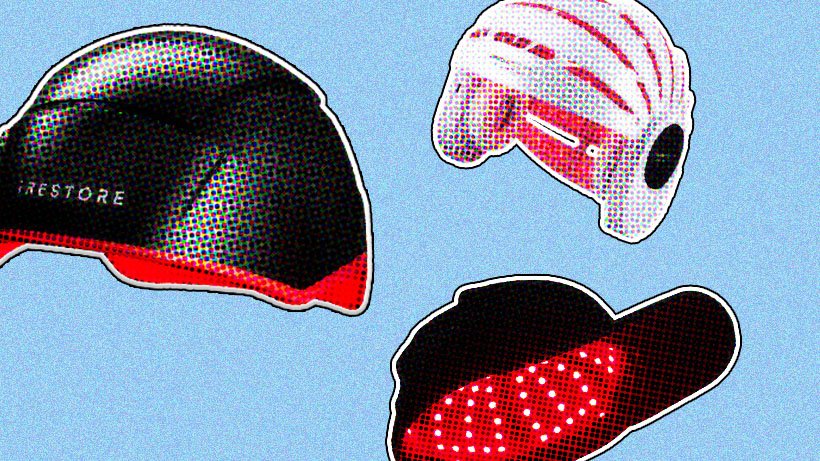
We’ve reviewed every major red light therapy device for hair loss, and here are our top picks
Red light therapy has quickly become one of the more accessible ways to support hair regrowth at home. It’s not a cure for baldness, but from what we’ve seen, it can make a noticeable difference in thickness and growth—particularly if you’re dealing with androgenetic alopecia.
We’ve looked at the latest at-home devices to find the ones that are actually worth your time and money. This guide pulls together the standout options worth considering, along with the key things that actually matter—from how the tech works to how to use it in a way that fits into your routine.
Quick summary: Best red light therapy devices for hair loss
- iRestore Elite: Best overall
- iRestore Professional: Best mid-range option
- Kiierr Laser Cap Hair Growth System: Best laser-only option
- HigherDOSE Red Light Hat: Best on the budget
- Illumiflow 272 Pro Laser Cap: Best laser-only on a budget
Red light therapy devices compared
DevicePrice Device typeWavelenght(s)Lasers or LEDsSession time FDA-clearance iRestore EliteFrom $1,799Helmet625nm, 655nm, 680nm
Both12 minutes per dayYesiRestore ProfessionalFrom $799Helmet650nmBoth25 minutes per day YesKiierr Laser Cap Hair Growth SystemFrom $799Cap650nmLasers From 30 minutes per day (depends on the model) YesHigherDOSE Red Light Hat
$449Cap650nmLEDs10 minutes per day YesIllumiflow 272 Pro Laser Cap$899Cap650nmLasers 30 minutes every other day Yes
What to look for in a red light therapy device for hair loss
If you are looking for a red light therapy device for hair growth, keep these aspects in mind:
- Wavelength range. For hair, wavelengths of 630–680nm are commonly used.
- Coverage. On the market, you can find devices for more targeted areas (usually combs), but full scalp options are more widely available.
- Power output. More powerful devices require shorter sessions; however, they are more expensive.
- Device type. Some of the most common hair-loss devices are helmets, combs, and caps. The best for you will depend on your preferences.
- Certifications. Look for products that have FDA clearance or other relevant certifications.
Advertisement
Your choice mainly comes down to budget vs. session time: more powerful devices cost more but require shorter daily use.
How we tested these red light therapy devices
At Wareable, we emphasize testing products. This helps us identify major advantages and disadvantages, but we don’t rely solely on our personal experience. We read through customer reviews and, for certain products, including red light therapy, we also look at the scientific data.
When it comes to red light therapy devices, there’s no one-size-fits-all solution. Different devices target different needs, whether it’s shorter session times, full scalp coverage, or more budget-friendly options for those not ready to go all-in.
This is why we not only looked at the products but also sought options for different target groups. In the end, we chose high-quality devices that cater to everyone, from first-timers on a budget to those committed to the most powerful options.
iRestore Elite
Best for: Users looking for a premium at-home device
Advertisement
- Wavelengths: 625nm, 655nm, and 680nm
Advertisement
- Session time: 12 minutes per day
At $1,799, the iRestore Elite sits firmly in premium territory. It’s the most expensive option on this list—but it’s also the most powerful, with the most advanced setup.
That becomes clear when you look at the details. It uses three wavelengths, more than any other device here, which means it can target hair follicles across a broader part of the light spectrum.
The diode count stands out even more. With 500 in total—nearly double the next closest rival—it covers more of your scalp in one go. In practice, that means shorter sessions. We found the 12-minute routine easy to stick to, and it’s one of the quickest we’ve come across.
This is a full helmet, so it’s not something you’ll casually wear during a video call. But in our testing, it didn’t feel as bulky as it looks, and it’s light enough that sessions stay comfortable rather than feeling like a strain.
ProsConsThe most powerful device on the listSerious upfront priceOnly needs to be used for 12 minutes per dayDeeper, more comprehensive stimulation3-year warranty that can be extended to 5 yearsFDA clearanceImpressive 12-month money-back guarantee
Advertisement
iRestore Professional
Best for: Users looking for full scalp coverage
- Session time: 25 minutes per day
At $799, the iRestore Professional sits in a more balanced spot. It’s a clear step down in price from the $1,799 Elite, but still feels like a serious investment compared to more budget-friendly options like HigherDOSE.
You do give up some power here. Sessions are longer at 25 minutes a day, but it still delivers full-scalp coverage that’s consistent enough for most people.
It shares some key strengths with the Elite. You’re still getting FDA clearance and a 365-day money-back guarantee, which helps justify the price. The warranty is slightly shorter, though—2 years as standard (extendable to 4), compared to 3 years on the Elite (extendable to 5).
Advertisement
In everyday use, we found this helmet easy to live with. It’s lightweight and comfortable, even during longer sessions. And while it has fewer diodes than the Elite (282 vs. 500), the mix of LEDs and lasers helps maintain even coverage across the scalp.
ProsConsHalf the price of the EliteNot the most budget-friendly optionFull scalp coverage with a solid number of diodesOnly one wavelengthFDA-cleared deviceFeatures both LEDs and lasers12-month money-back guarantee
Kiierr Laser Cap Hair Growth System
Best for: Users who prefer a laser-only device
- Session time: Depends on the model, from 30 minutes per day (every other day)
Advertisement
Advertisement
Kiierr sits in the mid-to-premium price range, with devices starting at $799 and going up to $1,199 for the top model. The main difference between them comes down to diode count—pay more, and you’re getting a more powerful setup.
That also affects how much time you’ll need to commit. At the top end, sessions take just 6 minutes a day, while the more affordable option stretches to 30 minutes every other day. From our perspective, it’s worth choosing based on how easily that routine fits into your day.
Like iRestore, Kiierr is FDA-cleared, but the approach is different. Kiierr uses lasers only, while iRestore mixes lasers and LEDs. Lasers produce more focused light, which can be more effective—but they also drive the price up. If you’re looking for something simpler and more affordable with LEDs only, HigherDOSE is the more straightforward option.
In day-to-day use, we found it easy to set up and get started. It’s a simple system, and we didn’t run into any issues—something that’s also reflected in user feedback. The main limitation is the fit. The cap isn’t adjustable, so it won’t suit every head size, which is worth keeping in mind before buying.
ProsConsMultiple options depending on your budgetOnly one wavelengthFDA-cleared deviceNot the most budget-friendly solutionUses lasersPositive customer feedback7-month money-back guarantee
HigherDOSE Red Light Hat
Best for: Users who prefer an LED-only device
Advertisement
- Session time: 10 minutes per day
Advertisement
Compared to the Kiierr, the HigherDOSE cap relies entirely on LEDs rather than laser diodes, and that’s a big part of why it comes in at a lower price point. LEDs are generally cheaper to manufacture, which keeps production costs down.
Both LEDs and lasers have shown results in clinical studies, though some research gives lasers a slight edge. We don’t think that’s a dealbreaker here, especially at this price point—the trade-off between LED and laser is more about budget than effectiveness.
In the end, we still consider HigherDOSE one of the best red light therapy caps for hair loss, thanks to other important factors such as FDA clearance, making it a well-rounded option, especially in this price range.
ProsConsUses only LEDs to offer the lowest price of the reviewed productsOnly one wavelengthFDA-cleared deviceFewer diodes (120) compared to the competitorsPositive customer feedback
Advertisement
Illumiflow 272 Pro Laser Cap
Best for: Budget-conscious buyers
- Session time: 30 minutes every other day
Advertisement
At $899, the Illumiflow 272 Pro lands squarely in the middle. It’s cheaper than the Kiierr 272 Premier ($1,199) and both iRestore helmets, but still a step up from more affordable options like the HigherDOSE Red Light Hat ($449). Where it stands out is value—it matches Kiierr’s 272 laser diodes while coming in at a lower price.
The trade-off is the brand itself. Compared to Kiierr, Illumiflow is less established, with fewer customer reviews and a noticeably weaker reputation online. Kiierr holds an A+ BBB rating, while Illumiflow sits much lower, which is something we’d factor in before buying.
That said, on paper and in use, the core offering is still solid. Both devices are FDA-cleared, which means they meet the same safety standards. So if you’re focused on getting similar hardware for less money—and are less concerned about brand track record—this is where Illumiflow makes the most sense.
Advertisement
ProsConsCheaper than Kiierr, matches the diode countOnly one wavelengthLaser-only, 272 diodes per capWeaker online reputationFDA-cleared
How red light therapy works for hair growth
Red light therapy is not a completely new innovation. One of the earliest studies on red light therapy was published in 1968 when Dr. Endre Mester conducted experiments using laser light to promote wound healing in mice. What scientists also noticed was accelerated hair regrowth.
Today, studies on red light therapy are more sophisticated, but the proposed benefits are similar to those first observed, including support for hair growth.
But how can red light therapy have any effect on hair? In simple terms, red and near-infrared wavelengths (typically between 630nm and 900nm) are believed to penetrate the scalp and get absorbed by the mitochondria in hair follicle cells. This may boost the production of adenosine triphosphate (ATP), which is used as an energy source for hair growth.
However, this mechanism has not been definitively proven. But while we don’t really have a clear-cut answer on how it works, a growing body of clinical evidence suggests it may support improvements in hair density and thickness, particularly in cases of androgenetic alopecia, when used consistently over several months. These conclusions are supported not only by theoretical knowledge but also by clinical trials.
Lasers vs. LEDs for hair loss
When shopping for a red light therapy device, buyers will quickly notice that the market is split between two types of light sources—lasers and LEDs. Some devices, for instance, iRestore hemlets, use both. But the main question is, which is better for targeting hair loss?
Advertisement
Scientifically speaking, there is no clear-cut answer. Sometimes, lasers are preferred because they produce a more focused beam of light, with researchers speculating that this means more precise targeting.
While some research papers do indicate that lasers may perform better, this has not been settled for good yet, as we lack direct comparisons between these light sources. What we do know is that both types of light have shown benefits compared to placebo devices.
LEDs, however, have one clear advantage: they are cheaper to manufacture. This is why you will find them in more entry-level price options, such as HigherDOSE cap.
Our take: if the budget is tight—go with LEDs. If you can spend more and want the slight theoretical edge—laser-based devices are worth the upgrade.
How to use red light therapy for best results
First tip would be to always follow the manufacturer’s instructions. As seen in our reviewed products, session times can vary widely, from just 6 minutes per day to up to 30 minutes every other day. This is because different products come in different power ranges and may require different approaches.
The second tip is to be consistent. As seen in clinical studies, changes in hair growth take time, especially when you’re trying to shift follicles from the resting phase back into active growth.
Advertisement
And the last tip is to consider talking things through with your healthcare provider. Red light therapy works best as part of a broader hair care approach, and one of the crucial steps is to figure out what is causing the hair loss in the first place.
Safety and side effects
Red light therapy is considered to be generally safe, and no, it’s nothing like sun exposure. Unlike UV rays, red and near-infrared wavelengths don’t carry the energy needed to damage skin or tissue.
That said, some side effects can still crop up. Eye sensitivity is the most commonly reported—both in academic literature and user reviews—so protective eyewear is a must during sessions. Some people also report mild scalp irritation, particularly in the early stages of use. This typically subsides on its own, but if it persists, it’s worth reducing session time and consulting a dermatologist.
For more specifics, it is best to read the manufacturer’s official website, as different products may have different safety precautions.
Best red light therapy for hair loss: FAQ
Does red light therapy actually work for hair loss?
Yes, red light therapy has been clinically studied for certain hair loss causes and has been shown to be potentially effective. Most data on red light therapy and hair loss come from studies on androgenetic alopecia, a genetically inherited condition associated with progressive hair thinning and loss.
Who is red light therapy best for?
Currently, we have the most clinical data on people with androgenetic alopecia, although early findings suggest that it may also be beneficial for alopecia areata and telogen effluvium associated with long COVID.
Are at-home devices worth it for hair growth?
Yes, they may be beneficial for hair growth, especially in certain patients. That said, results take months of consistent use, so go in with realistic expectations and commit to a regular routine. Moreover, it is recommended to use other methods alongside red light, such as minoxidil.
References
- https://onlinelibrary.wiley.com/doi/abs/10.1002/LSM.22512
- https://pubmed.ncbi.nlm.nih.gov/37583500/
- https://pubmed.ncbi.nlm.nih.gov/38940108/
- https://pmc.ncbi.nlm.nih.gov/articles/PMC6737896/
- https://pubmed.ncbi.nlm.nih.gov/33678141/
- https://pmc.ncbi.nlm.nih.gov/articles/PMC8675345/
- https://pmc.ncbi.nlm.nih.gov/articles/PMC3782468/
Advertisement
