

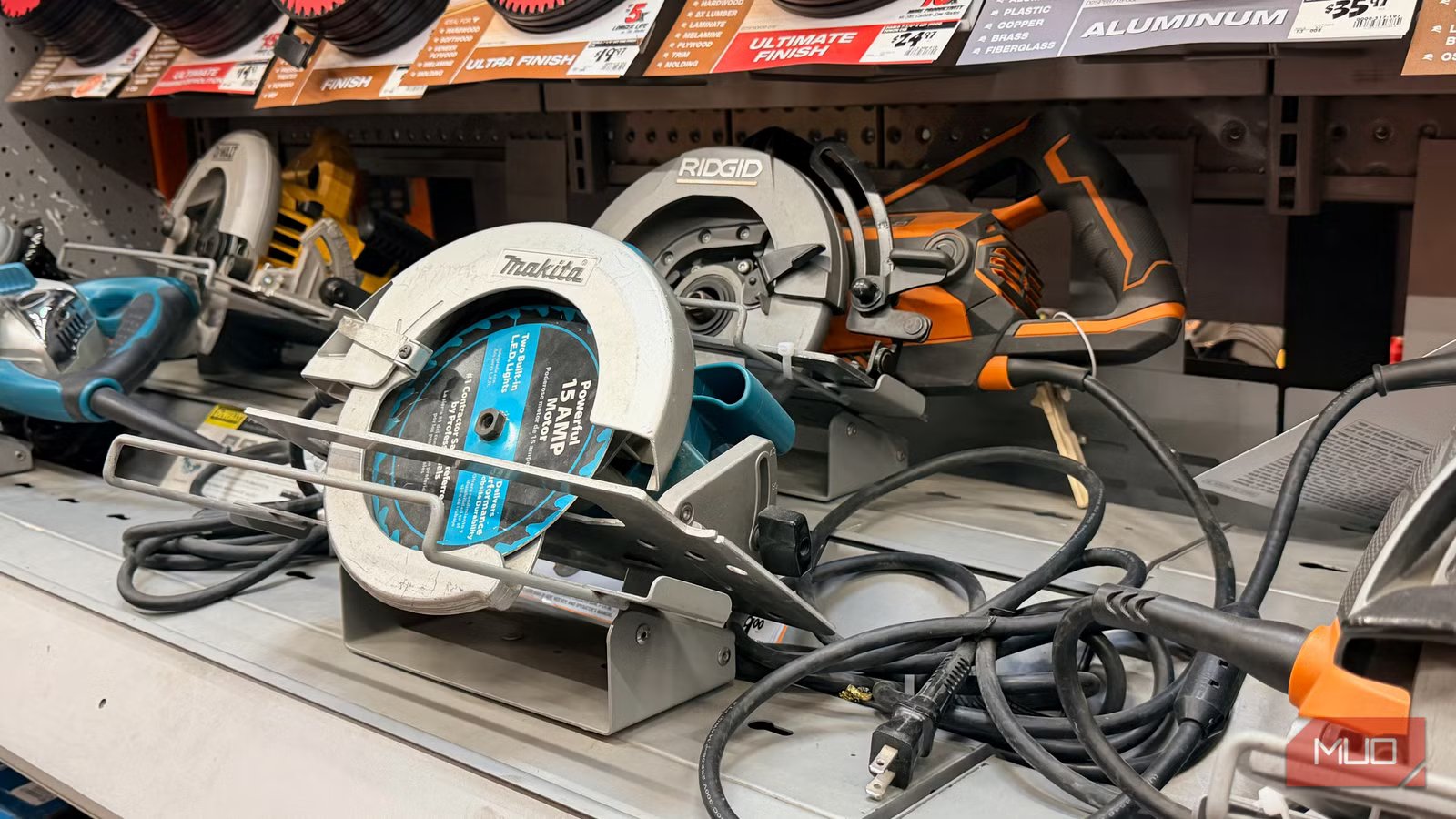
You’ll likely drop a lot of cash on the essential power tools themselves, but you don’t need to spend a fortune on the accessories. The markup on name-brand drill bits, saw blades, and sanding discs is significant, and for most household and hobby-level tasks, the performance difference between a premium accessory and a budget one is minimal.
Drill bits, saw blades, sanding discs, and more are available at a fraction of what major brands charge, and knowing which ones are safe to go cheap on is half the battle. Here are the best affordable accessories to stock up on for your Milwaukee and other brand power tools.
Sanding discs and angle grinder discs that power through any project
The one safety check you can’t skip with budget abrasives
If you use a random-orbit sander regularly, you already know sanding discs go fast. Buy them in bulk from off-brand suppliers to cut costs. For furniture prep, deck refinishing, or woodworking, the quality difference between a bargain 50-pack and a name-brand is minimal. The same goes for sanding sheets for belt and detail sanders. Grab a variety pack with multiple grits (80, 120, 180, and 220) to cover everything from rough stock removal to finish sanding.
Angle grinder discs wear out quickly, too. This is especially true when cutting rebar, trimming tile, or grinding welds. Budget discs from overseas are adequate for occasional use. Buying multi-packs keeps the per-disc cost low. Stick to reputable online retailers. Always check that discs match your grinder’s RPM rating. For grinding discs, a 10-pack of 4.5″ flap discs in 40 or 60 grit gives you plenty of material removal ability at low cost.
There are also detail sanders (also called mouse sanders or corner sanders) that use triangular sheets that can be hard to find locally at reasonable prices. Buying multi-packs online in assorted grits is the practical move, and off-brand sheets attach and perform comparably to brand-name equivalents. These are particularly useful for getting into tight corners on furniture, trim work, and cabinet doors where a standard random orbit sander won’t fit.
Drill bits and driver bits aren’t the same thing and you need both
How much should you spend on each?
Bryan M. Wolfe / MakeUseOf
When in a hardware store, it’s not too difficult to confuse drill bits and driver bits because both fit the same tool, but they do completely different jobs. Drill bits, such as ones for the popular RYOBI ONE, bore holes and have a fluted, pointed tip designed to cut into wood, plastic, drywall, or masonry. By contrast, driver bits drive fasteners, with shaped tips (Phillips, flathead, Torx, square) that work with screw heads. Having both types on hand means your drill can actually do everything it’s designed to do.
A basic twist-bit drill bit set from 1/16″ to 1/2″ usually costs under $20 on Amazon and can handle wood, plastic, and drywall. For regular projects, a budget twist bit is fine to purchase, and you can avoid the more expensive name brands. For masonry or concrete, invest in a masonry set, as cheap options can wear out quickly.
Driver bits are even cheaper. Stripping screws signals a tired or poor-quality bit, but premium prices aren’t necessary to avoid it. Reliable sets from IRWIN, Bosch’s budget lines, or generic Amazon kits with magnetic holders and a variety of common tips cover general needs. Buy a 30-piece set for under $15 to handle almost any fastener.
Circular and jigsaw blades don’t require a premium price
Why tooth count matters more than the name on the blade
Bryan M. Wolfe / MakeUseOf
Saw blades wear out, and replacing them regularly is part of owning a circular saw. Brand-name blades from Diablo or Freud are excellent, but a budget blade from a lesser-known manufacturer works surprisingly well for rough cuts in dimensional lumber or sheet goods. Look for blades with carbide-tipped teeth since they last longer than high-speed steel, and pay attention to the tooth count: fewer teeth (around 24) for ripping lumber, more teeth (40 to 60) for crosscutting and cleaner finishes.
Meanwhile, it’s important to recognize jigsaw blades as consumables, and treating them as such changes how you shop for them. A dull blade doesn’t just slow you down; it also burns wood and puts extra stress on your tool. Once you accept that blades wear out and need replacing, the smarter move is to buy ahead of the need rather than scramble for a replacement mid-project.
Multi-packs of T-shank blades compatible with most modern jigsaws are widely available for under $15 and often include blades rated for wood, metal, and plastic. It’s a lot easier to have a variety on hand than to hunt down individual specialty blades, especially when you’re working with materials that require different tooth counts or blade lengths.
Besides, with an inexpensive multi-pack, you can swap them out the moment they start to drag without worrying about cost. That’s the real payoff: you stop babying a blade that’s past its prime and start cutting cleaner from the first stroke.
Hole saws and reciprocating saw blades that cut through almost anything for less
Why bi-metal construction is worth the small step up in price
Credit: Amazon
Instead of buying pricey brand-name hole saws individually, get an off-brand bi-metal kit for under $30. It cuts wood, drywall, and thin metal just fine.
For recessed lighting, cables, or speaker boxes, a single kit covers all the sizes you need. Use cutting oil or wax on metal to keep blades sharp.
Do the same with reciprocating saw blades. Choose a value multi-pack for wood, nail-embedded wood, and metal rather than pricey singles — unless you need precision. Bi-metal blades last longer, especially when hitting nails. Packs of 10+ blades cost under $20 and cover most demo or rough cuts.
Cheap accessories are smart accessories
Spending less on consumables and accessories means you can replace them when they’re worn out rather than stretching them past their useful life. Using fresh accessories makes a noticeable difference: you’ll get cleaner cuts from your bits and blades, and you won’t have to fight your sander to get a smooth finish. For most power tool accessories, the budget option works, and working smarter with your tool budget leaves more room for the tools themselves.
