

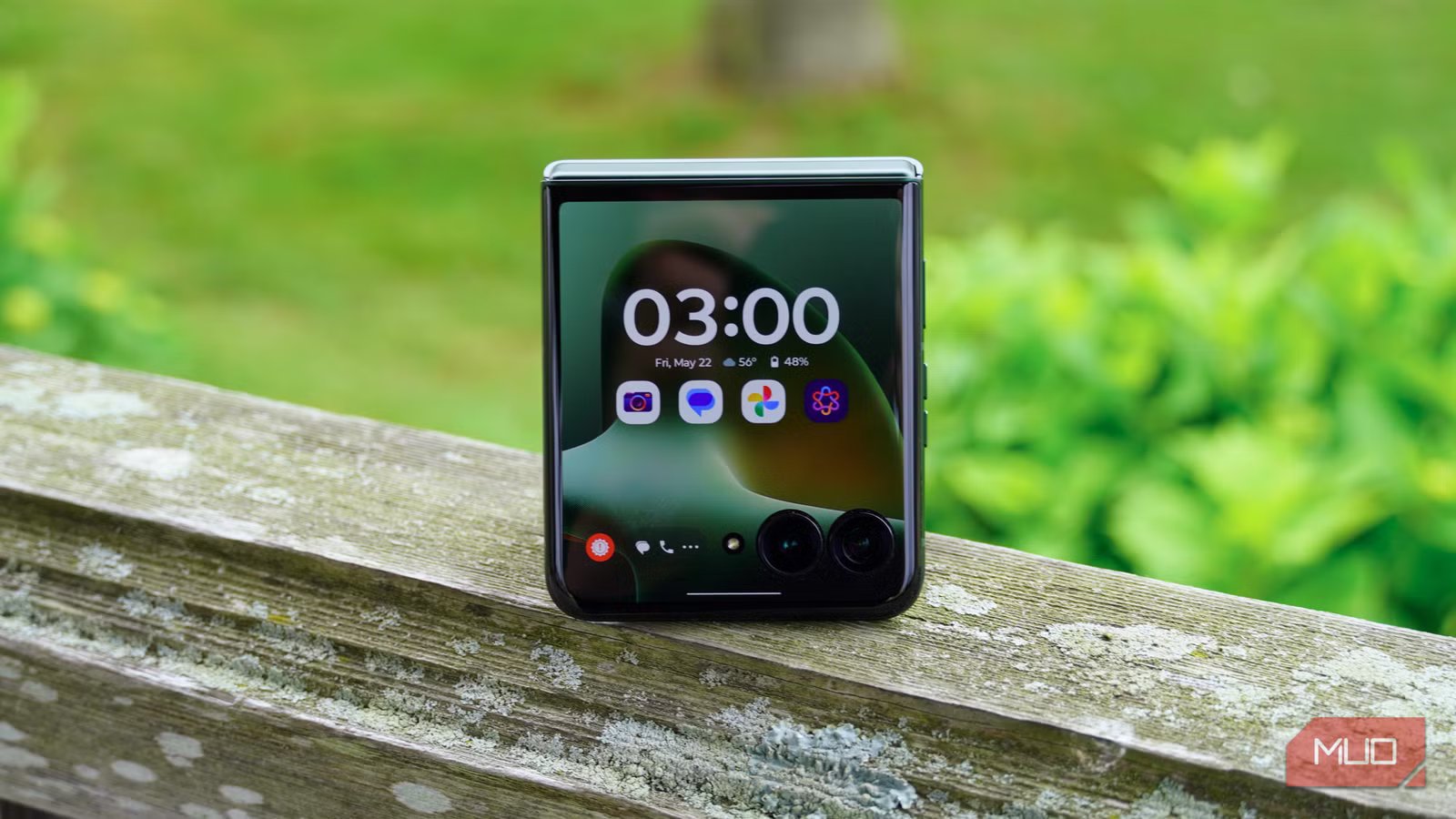
I’ve been using the Motorola Razr Plus 2026 alongside its siblings, the Razr 2026 and Razr Ultra 2026, for roughly two weeks. I’ve also revisited the Samsung Galaxy Z Flip 7 for good measure, and one thing immediately became clear: the Razr Plus 2026 is an enigma. This flip phone is incredibly easy to write off on paper thanks to its $100 price increase and minimal upgrades. Make no mistake, I’m going to dig into the Razr Plus 2026 for reusing the Snapdragon 8s Gen 3 processor for the third straight year, having the smallest battery in the Razr 2026 lineup, and making a questionable camera lens swap.
Putting those criticisms aside, the Razr Plus 2026’s price hike isn’t a death sentence. It costs the same as the Galaxy Z Flip 7, and there are arguments to be made for the Razr Plus 2026 being a better phone than Samsung’s premier flip. It’s certainly the sensible option in Motorola’s own lineup, falling in between the $799 Razr 2026 and the $1,499 Razr Ultra 2026. No one with a Razr Plus 2024 or Razr Plus 2025 should feel compelled to upgrade to the latest model. However, new foldable buyers might find that the Razr Plus 2026 is the Goldilocks flip phone — it’s nothing special, but also just right.
Motorola sent us the Razr Plus 2026 for review. It had no input on the contents of this article, and didn’t see it before publishing.
7.5/10
SoC
Qualcomm Snapdragon 8s Gen 3 Mobile Platform
RAM
12GB
Storage
256GB
The Razr Plus 2026 is the awkward middle child of the Motorola flip phone lineup, but it’s well-positioned to beat the Galaxy Z Flip 7. The two phones have the exact same price tag, but the Razr Plus 2026 has a bigger battery, faster charging, a better camera system, and superb cover screen app support. Unfortunately, it also comes with an aging Snapdragon 8s Gen 3 chip paired with 12GB of RAM and 256GB of storage.
Pros & Cons
- 4,500mAh battery and fast charging beats Samsung
- 4-inch cover screen offers unrestricted Android app use
- Dual 50MP rear cameras for high-res mobile photography
- Price is high for a phone with a three-year-old processor
- Battery is smallest of the three Razr 2026 models
- Thicker than the Galaxy Z Flip 7
Motorola Razr Plus 2026 pricing and availability
The Motorola Razr Plus 2026 is widely available for purchase as of May 21, 2026. It retails for $1,099.99 and is available in a single 256GB configuration and one Pantone Mountain View (green) colorway. You can find the Razr Plus 2026 at retailers like Best Buy and Amazon, as well as on Motorola’s website. If you buy from Motorola, you’ll get a free pair of Moto Buds Loop open earbuds for a limited time. The Razr Plus 2026 is also available at AT&T and will arrive at T-Mobile at a later date.
SoC
Qualcomm Snapdragon 8s Gen 3 Mobile Platform
RAM
12GB
Storage
256GB
Battery
4,500mAh
Operating System
Android 16
Dimensions
88.1 x 74 x 15.3 mm (folded)
Colors
Pantone Mountain View
Weight
189 grams
Charge speed
45W wired, 15W wireless, 5W reverse wired
IP Rating
IP48
Release date
May 21, 2026
Main Camera
50 MP, f/1.8
Wide-Angle Camera
50 MP, f/2.0, 122˚
Cover display
4-inch AMOLED, 165Hz, 2,400 nits
Interior display
6.9-inch AMOLED, 165Hz, 3,000 nits
Audio
Stereo speakers, Dolby Atmos
Software Update Policy
3 years of Android OS upgrades
The Razr Plus 2026’s design challenges the Ultra
It’s thinner and lighter, with a gorgeous finish
The Razr Plus 2026 only comes in one color, and it’s a looker. It’s officially called Pantone Mountain View, but it’s a deep green complete with a textured finish on the back and matte aluminum side rails. Green isn’t my go-to color, but even I could appreciate the gorgeous appearance of the Razr Plus 2026. If you’d rather have another color, you’ll have to consider the base Razr 2026 or premium Razr Ultra 2026.
There’s something unique about the Razr Plus 2026’s design — it’s the thinnest flip phone in Motorola’s current lineup. We’re talking about fractions of a millimeter here, but these minute differences matter when comparing the Razr Plus 2026 to the 13.7mm Galaxy Z Flip 7. Motorola’s mid-tier clamshell foldable measures 15.3mm thick when shut, and it only weighs 189 grams. That’s just one gram heavier than the Flip 7, so if you want a flip phone with a fit and finish refined enough to compete with Samsung, this is it.
Credit: Brady Snyder / MakeUseOf
The external display of the Razr Plus 2026 is covered with Gorilla Glass Victus, and it could be due for an upgrade. The surface of the Razr Plus 2026’s cover screen is very glossy and reflective, and since the display panel isn’t very bright, this makes outdoor visibility harder than I’d like. A glass surface with an anti-reflective coating could’ve been beneficial here. The cover screen will collect dust and fingerprints quickly, especially around the camera lenses.
This phone’s design shares quite a bit in common with the Razr Ultra 2026, which makes it all the more impressive that the Plus model is both thinner and lighter. Like its premium counterpart, the Razr Plus 2026 uses a titanium hinge and has an IP48 rating against dust and water ingress.
Related
I tried all three Motorola Razr 2026 models, but only one is worth your money
Motorola’s flip phone lineup is still more versatile than just about every other brand. It’s also more expensive, and similar to the Razr 2025 series.
The same unrestricted cover screen, for $400 less
The best part of the Ultra is its 4-inch cover screen, and it’s here
The Motorola Razr Ultra 2026 stands out because of its expansive cover screen that can run any Android app, and it’s excellent that the Razr Plus 2026 offers a nearly identical cover screen. A good flip phone cover screen lets you do almost everything without unfolding the device, and the base model’s 3.6-inch cover screen can feel constrained at times. Upgrading to the Plus model is worth it, because you can do so much more with the larger display.
The Razr Plus 2026 has a 4-inch AMOLED panel that’s large enough to comfortably run apps like Google Messages, Gmail, and Chrome. I even use less optimized apps, such as Apple Music and Tesla, on the Razr Plus 2026 cover screen to change songs or unlock my car. As for the hardware, the cover screen supports up to 165Hz refresh rates and 2,400 nits of peak brightness. The brightness leaves something to be desired, and it’s a step behind the 3,000-nit Razr Ultra 2026 cover screen. Everything else is top-notch, though.
Credit: Brady Snyder / MakeUseOf
The brightness is my only criticism of the Razr Plus 2026’s displays, and it carries over to the 6.9-inch foldable AMOLED. This screen only goes up to 3,000 nits, and it doesn’t feel like enough considering the reflective nature of the plastic display covering. It can be hard to see in direct sunlight, and pales in comparison to the Razr Ultra 2026’s main display with its 5,000-nit peak brightness rating.
With 165Hz refresh rates and 10-bit color, the main screen is otherwise stunning. Crucially, the 22:9 aspect ratio helps it feel like a regular smartphone when unfolded. The thickness shrinks down to just 7.09mm when the Razr Plus 2026 is opened, creating a slim and natural feel.
Related
The Motorola Razr Ultra 2026 is a great phone, but keep your eyes off the price tag
The Razr Ultra 2026 isn’t a bad phone, but it has a bad price.
Motorola killed the thing that made the Plus special
Was ditching the telephoto in favor of an ultrawide the right choice?
Credit: Brady Snyder / MakeUseOf
I’ve been wondering whether Motorola really needs three clamshell foldable models ever since the Ultra variant was added to the lineup last year. Flip phones are rare to begin with, and Motorola is a niche smartphone brand on top of that. It appears like a slimmer lineup could be beneficial, but to Motorola’s credit, the Razr Plus 2025 had something going for it. That model was the only Motorola flip phone in its 2025 lineup with a telephoto camera, even if it offered a mere 2x optical zoom length. This year, the company swapped that 50MP telephoto for a new 50MP ultrawide lens on the Razr Plus 2026.
I don’t know how to feel about the decision. The telephoto lens was the one clear differentiator between the Razr Plus model and the base and Ultra models. It was also somewhat redundant. You can achieve optical-quality zoom at 2x lengths using primary sensor crop, so the dedicated 50MP telephoto arguably wasn’t offering that much value. By adding a 50MP telephoto lens with a 122-degree field of view to the Razr Plus 2026, it now has a hardware edge over the Galaxy Z Flip 7. So, I don’t like how “samey” the entire Razr 2026 lineup feels, but the new wide-angle lens is a net-positive upgrade for the Plus.
Getting two 50MP rear camera sensors on a $1,100 flip phone is pretty neat, and the system produces photos like the ones below:
The sharp lenses did an excellent job of reproducing scenes with detail, and didn’t oversaturate the colors. Granted, these captures were taken on a cloudy and dreary day, but I was nevertheless satisfied with the results. Motorola is using Pantone-validated color science paired with Dolby Vision video recording. It can veer too hard into vibrancy and less into lifelike reproduction at times (although that’s true of most smartphone cameras these days).
The key perk of using a Razr camera is its software. I enjoy using the foldable form factor to my advantage when snapping shots with a device like the Razr Plus 2026. That includes using the rear cameras for selfies and trying out features like Camcorder mode. With the new telephoto camera, the Razr Plus 2026 supports software-based horizon leveling and a new feature called “Tilt to Zoom.” You can twist your wrist to zoom in or out using the camera, and it’s a fun way to shoot video on a foldable.
Related
Motorola’s Razr 2026 software finally matches the hardware’s flair
Foldables are only useful if their software makes the most of their hardware. Luckily, the Motorola Razr 2026 series looks to do just that.
The Razr Plus 2026’s chip and battery don’t make sense
The Snapdragon 8s Gen 3 is here for a third straight year, and it’s puzzling
Credit: Brady Snyder / MakeUseOf
The most notable black mark on the Razr Plus 2026’s record is its processor — this device is powered by the same Qualcomm Snapdragon 8s Gen 3 mobile platform as the Razr Plus 2024. A smartphone model going three years without a chip upgrade is rare, and for good reason. The Snapdragon 8s Gen 3 was a midrange chip when it first debuted, and in the sense that even Qualcomm’s midrange SoCs now use more advanced process nodes, it hasn’t aged well. Luckily, this chip is paired with 12GB of memory and 256GB of storage, which is passable for the price point.
Surprisingly, the Razr Plus 2026 does keep up with the Galaxy Z Flip 7’s Exynos 2500 processor in single-core performance, and does alright for itself in AI workloads. The smartphone starts to show the age of its chip in multi-core and graphics-heavy benchmarks. It slots nicely between the Razr 2026 and Razr Ultra 2026 in terms of performance, and proved to be more capable than I expected.
Motorola Razr Plus 2026
Motorola Razr 2026
Motorola Razr Ultra 2026
Samsung Galaxy Z Flip 7
Geekbench 6 (single / multi / GPU)
1,911 / 4,532 / 6,683
1,106 / 3,175 / 3,233
3,058 / 8,074 / 19,942
1,988 / 7,272 / 19,292
Geekbench AI
3,001
1,835
2,728
4,036
3DMark Steel Nomad Light
749
424
2,120
2,249
Price
$1,100
$800
$1,500
$1,100
You probably won’t notice the Razr Plus 2026’s weak processor in everyday use. The Razr 2026’s paltry MediaTek Dimensity 7450X makes you consistently aware of the low-end processor due to constant lag and stutters, but the Razr Plus 2026 doesn’t have this problem. It runs great for daily tasks, although it is annoying that a mobile game could be a challenge for a $1,100 smartphone. This handset isn’t for gamers, that’s for sure.
The Razr Plus 2026 slots into an interesting position in the Motorola foldable lineup, as its 4,500mAh battery capacity is less than the Razr 2026 (4,800mAh) and Razr Ultra 2026 (5,000mAh). If you need the best battery life in a flip phone, the cheaper Razr 2026 claims that title. However, the Razr Plus 2026 does have a bigger battery than its predecessor and the Galaxy Z Flip 7, which is worth emphasizing. The fast 45W wired charging speeds will blow Samsung’s foldable out of the water, too.
Should you buy the Motorola Razr Plus 2026?
You should buy the Motorola Razr Plus 2026 if:
- You prefer Motorola’s approach to cover screen software
- You need a high-quality ultrawide camera on your foldable
- You get a great carrier deal on a Razr Plus 2026
You should NOT buy the Motorola Razr Plus 2026 if:
- You’d rather buy the faster Galaxy Z Flip 7 instead
- You can live with the Razr 2026’s compromises for $300 less
- You already have a Razr Plus 2024 or Razr Plus 2025
The Motorola Razr Plus 2026 left me surprised more than anything else. It’s woefully underpowered in some areas, like the processor, but also impressive in others, such as the camera and battery hardware. The battery makes the Razr Plus 2026 weak within the Razr 2026 lineup, although it becomes a key advantage when comparing the phone to the Galaxy Z Flip 7. The same can be said about the cameras. We can argue about whether the Razr Plus 2026 should’ve retained its telephoto lens, but having a 50MP secondary lens of any kind puts this phone ahead of Samsung’s best.
I’ve already written about how the Razr Ultra 2026 isn’t a realistic choice at its full $1,500 price point, but the Plus model is appealing at $1,100. Throw in a carrier discount — AT&T will give you this phone for under $160 with a 36-month contract and bill credits — and the Razr Plus 2026 becomes a downright good deal.
SoC
Qualcomm Snapdragon 8s Gen 3 Mobile Platform
RAM
12GB
Storage
256GB
Battery
4,500mAh
Operating System
Android 16
Dimensions
88.1 x 74 x 15.3 mm (folded)
The Motorola Razr Plus 2026 is a flagship flip phone with a 4-inch, edge-to-edge cover screen. It costs $1,099 and comes with a Snapdragon 8s Gen 3 chip, 12GB of RAM, and 256GB of storage. This phone has a 4,500mAh battery, which is the smallest capacity of the entire Razr 2026 series.
