

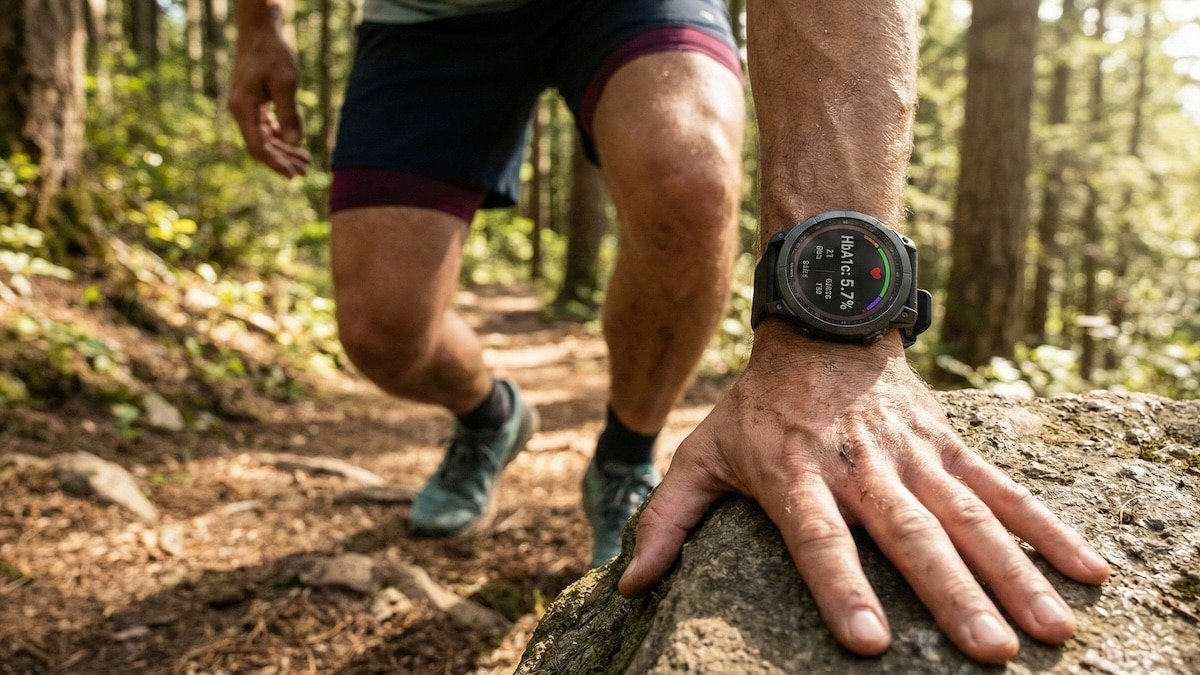
A new Garmin patent outlines how its wearables could estimate glycated hemoglobin (HbA1c) levels using light-based sensors. The method relies on pulse spectroscopy rather than traditional finger pricks or lab draws.
Garmin explores HbA1c estimation using wrist-worn devices
Garmin’s latest patent filing (US 2026/0033750 – Feb 5 2026) details a wrist-based system designed to estimate glycated hemoglobin using photoplethysmography (PPG). The concept involves sending light of different wavelengths into the skin, collecting the reflected signals, and running the data through algorithms to estimate the user’s HbA1c levels. The focus is on tracking long-term glucose trends, rather than instant blood glucose readings.
The key here is the use of multiple light bands to separate signals from oxygenated, deoxygenated and glycated hemoglobin. By calculating how light is absorbed at specific wavelengths, the system aims to derive ratios that reflect blood composition. These ratios would then allow the device to estimate not just oxygen saturation but also longer-term metrics tied to blood sugar control.
How it might work in practice
The diagrams in the filing show a typical Garmin-style smartwatch, with a sensor array on the underside that emits and detects optical signals. The system appears to rely on at least three separate optical signals, each at a different wavelength. These correspond to absorption bands used to differentiate between various blood constituents.
According to the technical flowcharts, the sensor records raw PPG signals, calculates AC-to-DC ratios for each signal, and then derives separate values for oxyhemoglobin, deoxyhemoglobin and glycated hemoglobin. The final HbA1c estimate comes from comparing the amount of glycated hemoglobin to the total hemoglobin content.
The system might also calculate two different blood oxygen saturation values, fractional and functional, depending on which hemoglobin forms are used in the equation. This suggests a broader interest in blood chemistry beyond just glucose.
The image below shows two ways a smartwatch can use light sensors to measure what’s happening under your skin. On the left, the sensors sit flat against the wrist, shining light in and picking up what bounces back. On the right, the sensors are slightly recessed into a small dip in the back of the watch, which may help block outside light and improve accuracy. In both cases, transmitters (TX) send out beams of light and receivers (RX) capture the reflected signal to learn about your blood and tissue.
A signal of where Garmin is headed
Garmin has already shown strong interest in expanding health insights across its wearables. VO2Max, respiration rate and stress metrics are common, while ECG support has made it to some devices. But non-invasive blood sugar tracking has remained elusive for the entire wearables industry, with few commercial breakthroughs.
This patent doesn’t guarantee a product. But it does show that Garmin is actively pursuing a method for tracking long-term glucose exposure without invasive hardware. In fact, this is the second such patent they filed over the past eight months. If successful, it could be particularly useful for endurance athletes, metabolic health tracking or pre-diabetic users looking for early insights.
This article originally appeared on Gadgets & Wearables, the first media outlet to report the story.
Source: US Patent Office
Subscribe to our monthly newsletter! Check out our YouTube channel.
And of course, you can follow Gadgets & Wearables on Google News and add us as your preferred source to get our expert news, reviews, and opinion in your feeds.
