

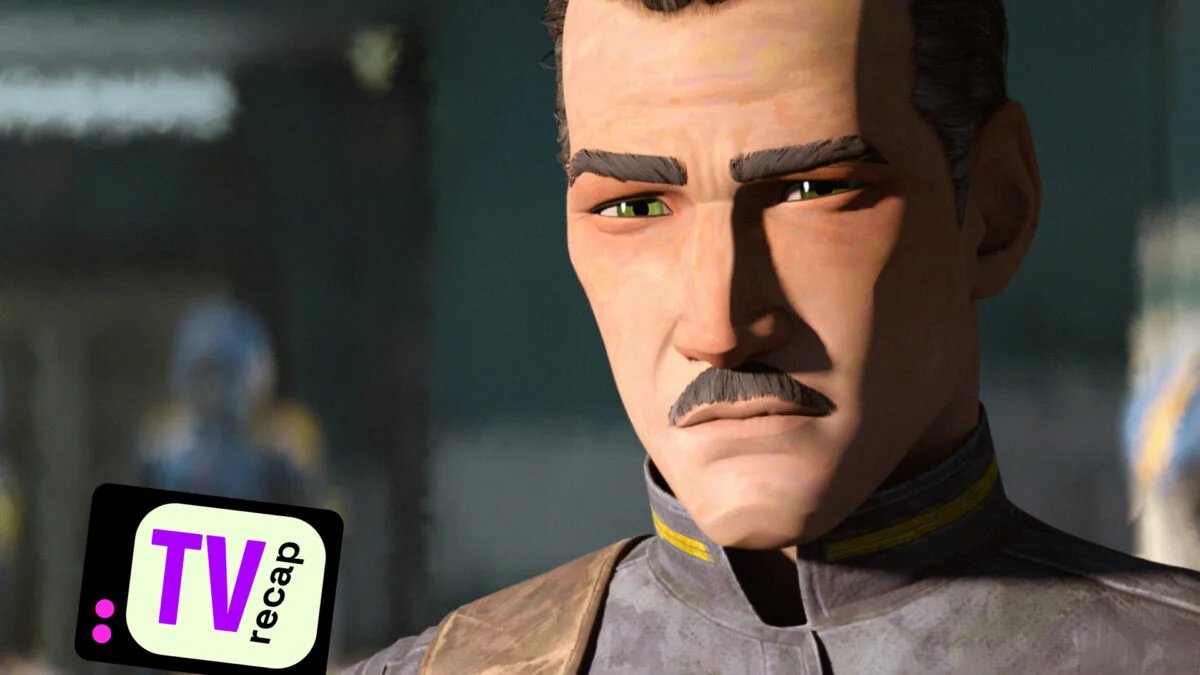
This week’s batch of Shadow Lord episodes are all about the vibe shift. But it’s not just Janix losing something when that happens—Shadow Lord loses a bit of something along the way, too.
For as good as the seedy crime noir feel the first four episodes of Shadow Lords have, there is something very compelling in just how different things feel coming into “Inquisition.” After last week’s cliffhanger of the literal Shadows of the Empire being cast over Janix, one of the most compelling things about this set of episodes is just how immediate and choking the Imperial fist is as it comes crashing down on the planet.
Crashing doesn’t even feel like the right word—the Empire arrives quickly, but it doesn’t do so with the immediate brutishness such a description would imply. One moment, it wasn’t there. Then a Star Destroyer is in the sky. How quickly we go from people looking up at that wedged shadow descending over them to just stormtroopers being everywhere, doing stop-and-searches, patrolling the transit systems, and turning Lawson’s office into this bustling yet chillingly quiet hub, white plasteel drowning out the blues of the Janix constabulary.
© Lucasfilm
Lawson’s office is where we really see the immediate impact the Empire’s presence has on Shadow Lord—it gets some force multipliers over this episode and next, to be sure, that take on the bulk of the narrative going forward—but it’s among these quiet cubicles that the show itself really tells us that the energy of the first four episodes, that back and forth between Lawson and Maul as everything grows out of hand, is done for. The arrival of Lieutenant Blake as the head of Imperial efforts on Janix sees Chief Klyce immediately knocked down a peg in the command chain, but then stormtroopers go to put their hands on her to take her to interrogation. She complies, willingly, and is escorted through a door in the background.
When it’s eventually Lawson’s turn, all we have left of whatever Klyce did, or even was, are jagged scratch marks clawed into the table in the room. No explanation is further needed. The vibe has shifted. She’s just gone, and that’s what the Empire is.
It then shifts further, of course, when Marrok the Inquisitor walks through the door, emerging from the shadows to place his hands on Lawson. It’s an undeniably cool shot—one of many throughout these two episodes, especially for a character best known up to this point for dying almost immediately after being introduced in Ahsoka and turning into a farty gas cloud—but it’s where the other shoe drops in this moment of the story: Shadow Lord is no longer the show it was even just a few episodes ago. Now it’s a show about the Empire and Inquisitors and Jedi on the run (with an ex-Sith thrown in, to boot).
© Lucasfilm
And while Shadow Lord tells that story well, it is a story we are painfully familiar with at this point in Star Wars storytelling. The rise of the Empire era is well-trod ground in general in contemporary Star Wars continuity—we’ve seen the Empire at its beginnings, we’ve seen tragedy after tragedy, we’ve seen the Rebellion coalesce in earnest in spite of all that. But we’ve had a lot of stories about the hunt for survivors of the Jedi purge, and while our characters don’t really get much time in either “Inqusition” or “Night of the Hunted” to mourn the loss of how quickly their lives have changed, beneath the glitz and glam of the action on display as Marrok tries to hunt down Devon and Master Daki (and eventually Maul), we definitely get to do a bit.
Again, this is not entirely a bad thing for the show. It’s a story we’ve seen done a lot in Star Wars recently, but it’s still done very well here. There is indeed some killer action, from a high-stakes gunship chase to Devon, Maul, and Marrok’s trainbound duel. There’s a palpable tension with Devon and Daki as the subjects of this hunt, at the very least, because we don’t know where their stories go like we do Maul’s. None of this is bad. It’s just familiar in ways that the most exciting things about Shadow Lord up to this point were not.
It’s fun that the cliffhanger of the first episode of these two is Lawson thinking he’d escaped the messed-up grip of the Empire at work to get home to his son, only to find two goddamn Jedi in his own apartment—as if there’s no way out for this to become a story about Jedi and Sith again. But it’s just a reminder for us as an audience, and it’s a shame that lesson for Shadow Lord‘s characters is also a moment for us to slip back into a very familiar mode. It’s similarly a shame that it also marks a moment where Maul really gets lost in his own show: he’s barely in these episodes, reacting to the Empire’s hunt for Devon and Daki from, well, the shadows, only showing his hand when he arrives to help Devon fight off Marrok. And yet, the show is still good enough, still visually exciting enough, that it sticks the landing for the most part with this slight misstep, even if it has to do so by doing such a compelling job of showing what happens when the Empire comes calling and how radically that changes the stakes of this story.
© Lucasfilm
I wrote last week that Shadow Lord‘s first act was about people refusing to let go of the old ways and learning the lesson that times had changed for the galaxy—Maul exploiting Devon’s anger at the twilight of the Jedi, and Lawson steadfastly getting more people hurt the more he doggedly held onto trying to think he could stop someone like Maul himself before the Empire could arrive. But in many ways, this week’s episodes are a reminder that the old ways and modes of Star Wars animation certainly haven’t left us yet.
Want more io9 news? Check out when to expect the latest Marvel, Star Wars, and Star Trek releases, what’s next for the DC Universe on film and TV, and everything you need to know about the future of Doctor Who.
