

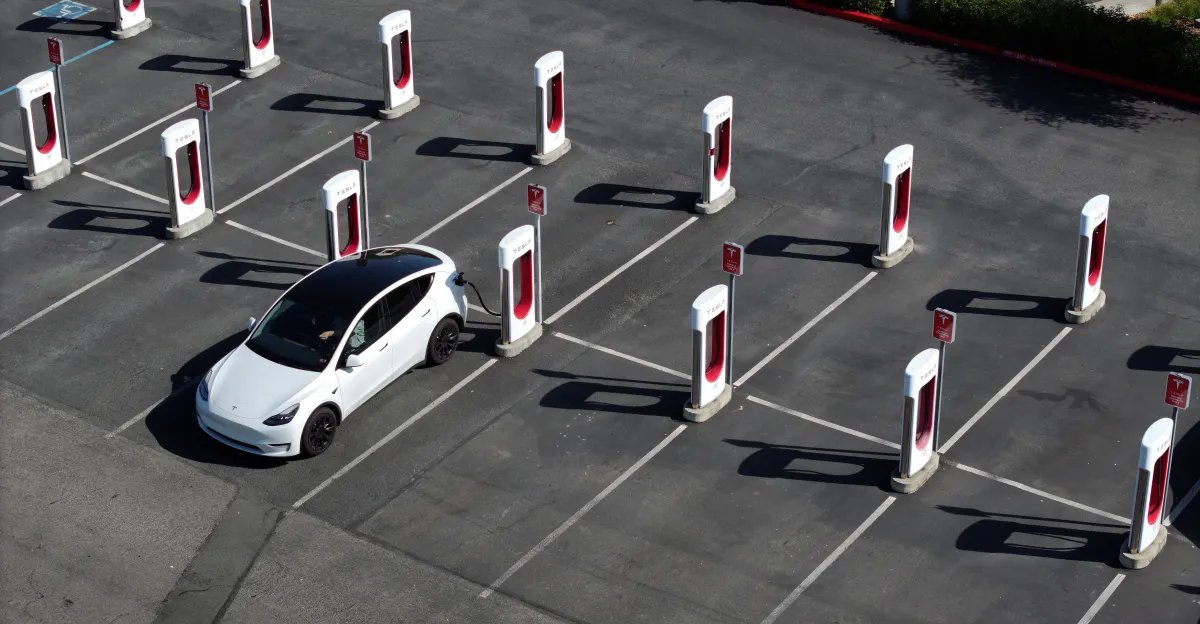
It seems clear at this point to say that Donald Trump does not want to spend a single dime on EV charging. He tried to freeze $5 billion in funding for the National Electric Vehicle Infrastructure (NEVI) program, which was approved as part of the Bipartisan Infrastructure Law. And when a federal judge ordered the government to unfreeze the funds, his administration came up with a new tactic to stall the plan.
EV chargers must now be built in the US, with components that also originate in the US, in order to receive federal funding, the US Department of Transportation said today. Under the proposal, EV chargers would need to boost their US-made parts from 55 percent to 100 percent in order to be eligible for NEVI funding. But industry and environmental groups say the new requirements would essentially stop EV charging build-out in its tracks.
“This proposal does not meet industry where it is today and may discourage further investment in the production of U.S.-made EV chargers,” Albert Gore, executive director of the Zero Emissions Transportation Association, said in a statement. “Ultimately, this will hinder the job growth that Buy America is intended to create.”
The reason, of course, is that most of the supply chain for EV charging equipment runs through China. Thanks to heavy government subsidies and years of investment, Chinese companies have largely supplied most of the EV charging stations that are installed in the US, Europe, and elsewhere.
The reason, of course, is that most of the supply chain for EV charging equipment runs through China.
And while US manufacturers are getting up to speed thanks to NEVI, there isn’t a single EV charging station online today that can say 100 percent of its materials and components originate in the US. According to Ingrid Malmgren, policy director at Plug In America, most of the enclosure, cables, and final assembly of chargers are currently built in the US, while the power modules and advanced electronics are sourced globally.
So, in a sense, this USDOT proposal is another de facto moratorium on EV charging build-out — at a time when a fast, reliable charging infrastructure is seen as crucial to keeping EV sales in the US afloat.
“This is yet another bad-faith attempt to kill NEVI and block the buildout of essential infrastructure Congress funded for all Americans,” said Katherine Garcia, director of the Sierra Club’s Transportation for All. “It would stall EV charging deployment, push the United States further behind, and deny communities access to clean, affordable transportation options.”
EV advocates say they support incremental increases in US-made charging equipment as a stipulation to receive federal funding, but that requiring 100 percent compliance right now is impossible. Malmgren called it “out of touch with U.S. manufacturing capacity.”
But halting the program is likely the real goal of Trump’s administration. For the past year, Trump has enacted policies to allow companies to pollute more, while restricting efforts to promote cleaner fuel alternatives, including EVs. If he was honest about wanting more EV charging manufacturing in the US, there would be a more realistic timeline to incentivize companies to build here. But as it stands, the proposal would essentially re-freeze the NEVI program right as it was getting moving again.
States were just starting to receive their promised NEVI funds when this proposal was announced. Georgia, for example, was counting on $134 million to build dozens of new charging stalls.
Follow topics and authors from this story to see more like this in your personalized homepage feed and to receive email updates.
- Electric CarsClose
Electric Cars
Posts from this topic will be added to your daily email digest and your homepage feed.
FollowFollow
See All Electric Cars
- NewsClose
News
Posts from this topic will be added to your daily email digest and your homepage feed.
FollowFollow
See All News
- PolicyClose
Policy
Posts from this topic will be added to your daily email digest and your homepage feed.
FollowFollow
See All Policy
- TransportationClose
Transportation
Posts from this topic will be added to your daily email digest and your homepage feed.
FollowFollow
See All Transportation
