

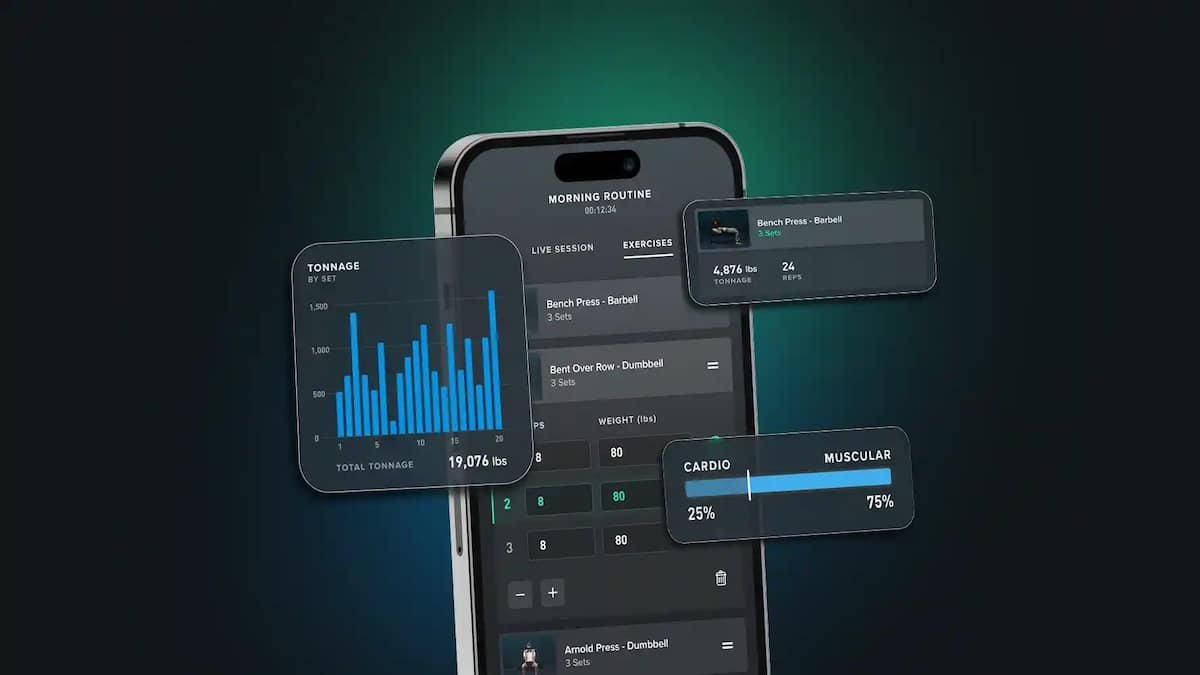
WHOOP has added a new Strength Trainer feature that measures muscular load from resistance workouts, not just heart rate. It uses weights, reps, sets and wrist movement to give lifting sessions more influence over Strain and recovery guidance. Users can also now follow PRs and history for each exercise.
Why this is useful
Most wearables still lean heavily on cardiovascular effort. That works well for running, cycling and endurance training, but it misses a big part of the picture in the gym. Lifting places stress on muscles, joints, bones and connective tissue, even when heart rate looks fairly controlled.
WHOOP’s approach is to combine cardiovascular load with muscular load. The user enters exercises, weights, reps and sets, while the device uses wrist-based motion data from the accelerometer and gyroscope. The system then applies different movement profiles, because a back squat clearly places a different demand on the body than a calf raise.
That is the bit that makes this more interesting than a glorified workout diary. WHOOP is not only asking what you lifted. It is trying to understand how much of the body a movement involves and how much stress that session added overall.
It still needs proper logging
There is a catch, of course. Strength Trainer works best when users log workouts properly. You can build a workout in advance, select a pre-built option or add Strength Trainer data to an activity after the session.
That makes sense for serious gym users, but it also adds a complication. Runners can usually press start and go. Strength training still needs structure, because the device cannot magically know the weight on the bar or the difference between a warm-up set and a working set.
WHOOP also says the feature currently needs wrist-based wear. That is important, because WHOOP Body apparel placements will not give the same movement data for this feature. So if you normally wear the sensor in clothing during workouts, Strength Trainer may require a habit change. The same applies to upper arm bands.
WHOOP AI joins the gym side too
The feature also plugs into WHOOP AI. Users can ask it to build strength workouts around goals, equipment, muscle groups or limitations. That could be useful for travel, minimal equipment sessions or training around injury, although the quality will depend on how sensible the generated workout actually is.
WHOOP is also adding Exercise Trends, which shows volume, history and personal records for individual exercises. That gives the feature a more practical angle. Instead of only seeing a single Strain number, users can track whether they are progressing on specific lifts over time.
For WHOOP, this feels like a necessary move. Recovery wearables have spent years explaining endurance load in great detail, while treating strength work as a secondary category. Strength Trainer gives lifting a clearer place inside the WHOOP system, and that should make the platform more useful for people who split their training between cardio and the gym.
The bigger question is whether users will stick with the logging. If they do, this could make WHOOP’s recovery guidance feel more realistic after heavy lifting blocks. If they do not, it risks becoming another clever feature that only the most disciplined users bother to feed with enough data.
