

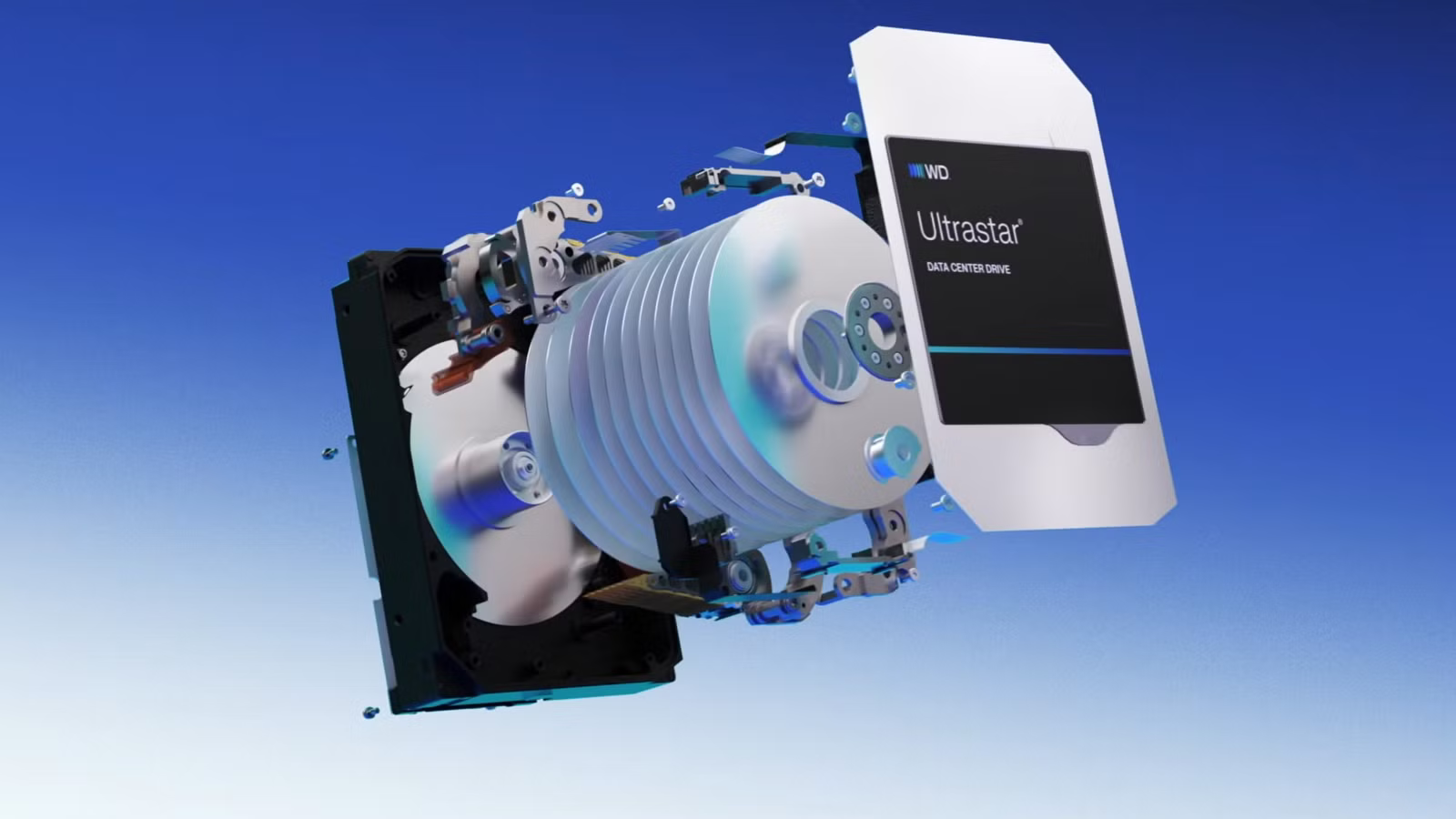
Fast solid-state drives have effectively replaced hard drives as the main storage devices on our computers. However, the hard drive itself still has a lot going for it where SSDs fall short. This means that not only are hard drive still common today, but that development of them has been ongoing.
The biggest drawback with hard drives compared with SSDs comes down to speed, but with clever engineering, a mechanical hard drive can compete with entry-level SSDs.
The performance trap classic HDDs fell into
Credit: Radu Bercan / Shutterstock
Why are hard drives so slow? The answer is complicated, but inside the drive there’s a spindle with spinning magnetic disks attached to it. There’s a vertical stack of read/write heads, and an actuator assembly that rapidly moves those heads to the correct part of the disk with the data you requested.
You can increase the storage capacity by making the data denser on the disk and adding more disks to the spindle, but with just one actuator you can only service one part of the drive at any given moment. This is the main reason that hard drives need defragmentation. If a file or a group of related files are physically scattered across the drive’s magnetic discs, then that one actuator has to constantly move the read heads around, increasing latency, seek times, and bringing your average throughput down dramatically.
SSDs don’t have this problem because they can instantly access any part of the memory store, and even do this in parallel. This is why a typical SATA hard drive might max out at 100-160MB/s while a SATA SSD using the same interface can clock up to 600MB/s, limited by SATA itself.
Dual actuators: Literally two “hands” on the job
Patting your head and rubbing your tummy at the same time is hard
On paper, the solution is simple: add more actuators. This is exactly how dual-actuator hard drives work. There are different ways to think about what this actually is. Inside one of these drives, you effectively have two hard drives stacked on each other.
There are two actuators with independent heads, each serving half of the platters. This is, in a way, the same sort of trick RAID is. But, RAID can only double your effective drive speed, while Western Digital claims to quadruple it. Specifically, the company claims that by using its dual-actuator technology combined with a “dual-pivot” design and high-bandwidth drive technology (HBDT) the speeds of its high-end drives can go from 300MB/s to 1200MB/s. Compare this with Seagate’s older dual actuator design, which topped out at 554MB/s.
Why this idea was so radical (and complicated)
Why’d you have to go and make things so complicated?
If this approach is so effective, why are we only doing it now? As you’ve probably already guessed, it’s not as simple as slapping some extra hardware in there. Hard drives are incredibly precise machines that work with mind-boggling small tolerances. It’s honestly a miracle they work at all, or that this level of engineering is even affordable to us mortals.
When you add an additional actuator, you start running into issues related to vibration, heat, and, of course, the complexity of coordinating the two sets of heads.
Credit: Western Digital
The first attempts at a dual-actuator drive had some drawbacks too. The main problem was that the two actuators were stacked vertically on the same pivot, which mean drive capacity sacrifices had to be made. The issue is that the whole reason the market wants higher-throughput hard drives is because hard drive capacities are really skyrocketing, now in the tens of terabytes. When we eventually have 100TB hard disks, you need much faster throughout to make use of it, otherwise you’re trying to drink the ocean through a straw.
Fast forward: Western Digital pushes the idea further
Credit: Western Digital
This is where the dual-pivot technology I mentioned earlier comes into the picture. In a dual-pivot design, the two actuators are not on the same side of the drive. Instead, they are on opposite sides, and each have their own pivot. this means you don’t need so much vertical space in the drive and the mechanical balance, which affects vibration, is now much better too.
Combining this design with that high-bandwidth architecture, and you start getting performance that makes sense for the massive hard drive capacities that are to come.
The legacy of a “bold idea”
So, those early dual-actuator drives were much faster than a normal hard drive, but because of the stacked single-pivot you had to sacrifice a platter, reducing capacity. Not only that, but these drives had parallel access limitatons, where only one read or write head could be active per actuator at a time.
This new generation of drive can actually add capacity thanks to the dual pivot, and now multiple paired read and write heads can be active at the same time. Just when we thought hard drives were completely obsoleted by SSDs, they go and catch up to two of the biggest strengths solid-state drives offer. Which means, in my opinion at least, hard drive technology will stay with us for the foreseeable future.
