

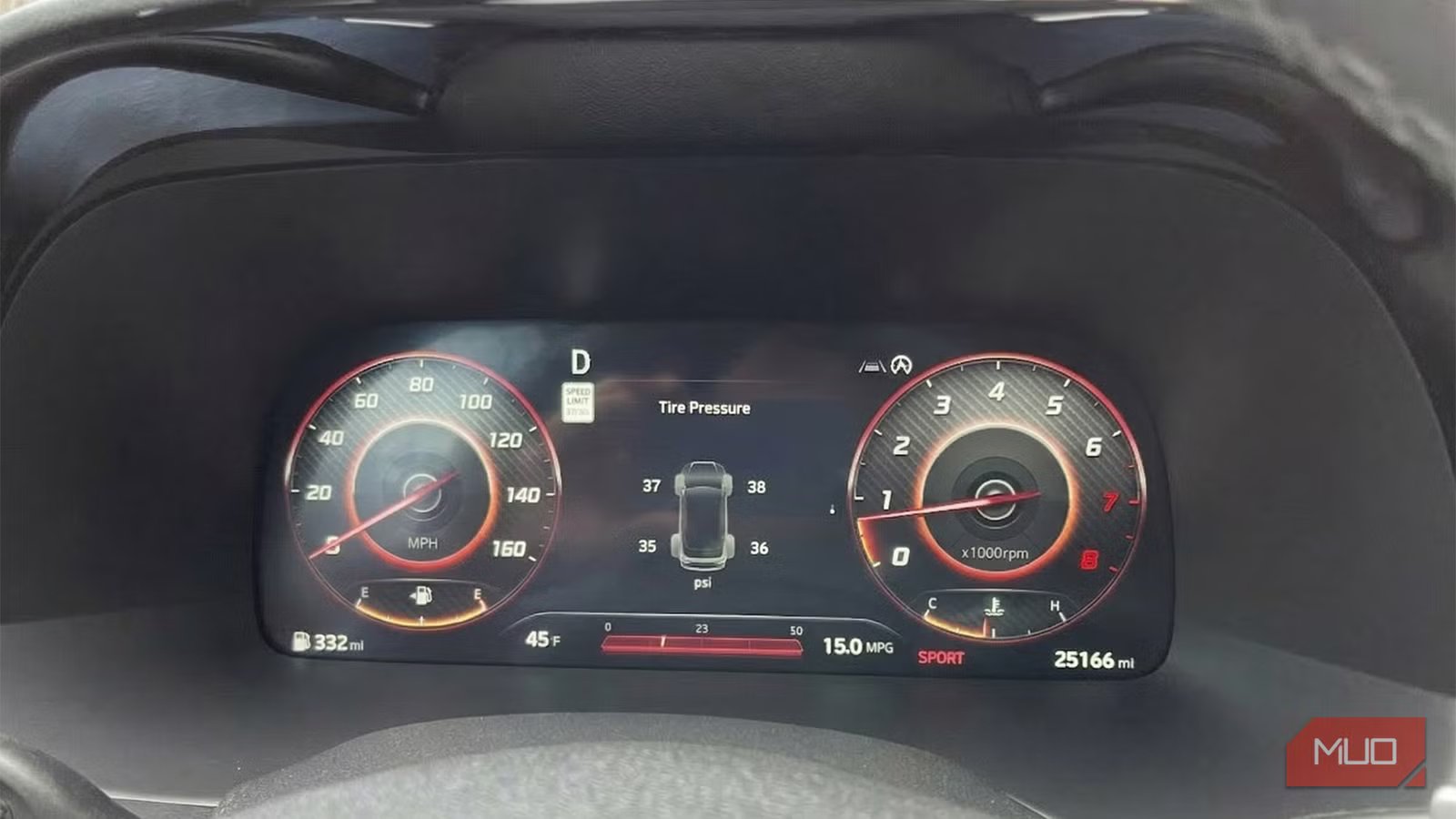
Any time a light turns on in a car’s dashboard, immediate panic rushes over you as a driver. Seeing the little symbols pop up makes you try to decipher what each one means to deduce the problem. If you’re a car person, you probably have no issue with this and were taught what each of them meant, so your mind focuses easily and you’re able to know the next step. If you’re like many of the rest of us, you have no clue and are already dreading opening up the car manual or bringing it into the shop.
One alert that can pop up on many modern cars is that your tire pressure is low. You’re looking for a horseshoe with an exclamation point in the middle of it to indicate that. If that pops up, you know you either need to put some air in the tires, or you potentially have a leak. But the sensors that are alerting you that your tire pressure is low may also be giving away your location to anyone who wants it.
Related
3 car gadgets I take on every road trip
I’ve driven from California to New Jersey, and these are the essential gadgets that powered my trip.
Your car measures your tire pressure through a system
The sensors work together to give information
Credit: Chris Hachey / MakeUseOf
A Tire Pressure Monitoring System (TPMS) became mandatory in vehicles under 10,000 pounds in 2007 in the U.S. and in 2012 in the E.U. It keeps an eye on how much air is in the tires and alerts drivers when one of them is underinflated by 25% or more.
Not only does it help prevent tires from failing or potentially popping, but it also boosts fuel economy and helps your car turn more efficiently and handle the roads better. Braking is another important factor in this, as properly inflated tires can stop more precisely.
There are two different types of TPMS that your car can have. There is an indirect TPMS, which uses an antilock braking system (ABS) wheel speed sensor that calculates if any tire is turning more slowly than the others, resulting from low tire pressure. This is what is picked up by your car’s computer system, which is what triggers the alert. Many manufacturers, such as Honda, Volkswagen, Audi, use indirect TPMS.
You could also have a direct TPMS, which has real battery-operated sensors inside each tire. They produce wireless signals to provide direct information from the tire to the car’s computer system when one is running out of air. If pressure falls to below 25% of the manufacturer’s recommended setting, it causes the light to come on. This is used by the majority of manufacturers, such as Chrysler, Dodge, Jeep, Ford, RAM, Hyundai, Acura, Nissan, and more.
If the tire pressure light comes on, it indicates that at least one of your tires is below the 25% threshold. If the light starts to blink, it means the TPMS might be damaged or malfunctioning.
Direct TPMS can be used to track your car
A recent study shows as much
Researchers at IMDEA Networks in Madrid, Spain, recently published a study titled Can’t Hide Your Stride: Inferring Car Movement Patterns from Passive TPMS Measurements. It shows that the wireless signals that the direct TPMS uses can be tracked. The problem with this is that the signals and transmissions are sent without encryption or are in any way secure. They even include a unique identifier that is specific to your vehicle.
Something like a low-cost spectrum receiver and antenna can capture the signals and monitor their movements. The receivers that the researchers used didn’t cost more than $100 and they deployed them over the span of 10 weeks. They were able to monitor signals from over 160 feet away, including through walls. This was particularly alarming because TPMS are supposed to be emitting low power signals.
Because of the Motor Vehicle Safety Act, which was passed in 2007, TPMS is a federally mandated safety feature
They tracked over 20,000 cars over that timeframe and the data even showed whether a truck was carrying cargo or if the size of the vehicle was a large one or a small one. The researchers were able to make inferences and hypotheses about some of the vehicles they tracked based on patterns. Through the collection of the data, they could understand more about certain ways people were going about their day consistently.
Their conclusions point to the fact that, through a wider network of surveillance, people can be tracked moving through entire cities for little time commitment and cost to the trackers. They found that linking a specific TPMS was easy to link to an individual, which could potentially reveal more personal information, such as a home address. You can also link one to a camera for easier tracking.
This is obviously something people need to be aware of
Unfortunately, it’s illegal to disable TPMS
Credit: Chris Hachey / MakeUseOf
Because of the Motor Vehicle Safety Act, which was passed in 2007, TPMS is a federally mandated safety feature. If you have an older car, you won’t be required to add one to your vehicle. Tampering with systems to make them inoperative could result in a fine. This can be spotted during a vehicle inspection.
While you might be able to interfere with the signals, maybe with things you plug into your car, it isn’t recommended to do so. It will be interesting to see if manufacturers do anything about the transmissions of the TPMS, such as encrypting them. The fact that this can be used to track cars from a distance is alarming. As noted in the report, there are existing proposals to enhance the privacy of TPMS.
Unfortunately, there hasn’t been any proven deployment of security enhancements yet. This will be something to watch for in the future for those looking into purchasing a new car. It may eventually be folded into standard safety features in vehicles.
Your TPMS could be giving away your location
Every car manufactured since 2007 uses TPMS to monitor tire pressure. Some use antilock braking systems to do this while others use sensors in the wheels to measure it. You can check in your vehicle’s manual which option yours has. It is worth noting that people can track the wireless signals produced by sensors to track locations of vehicles.
