

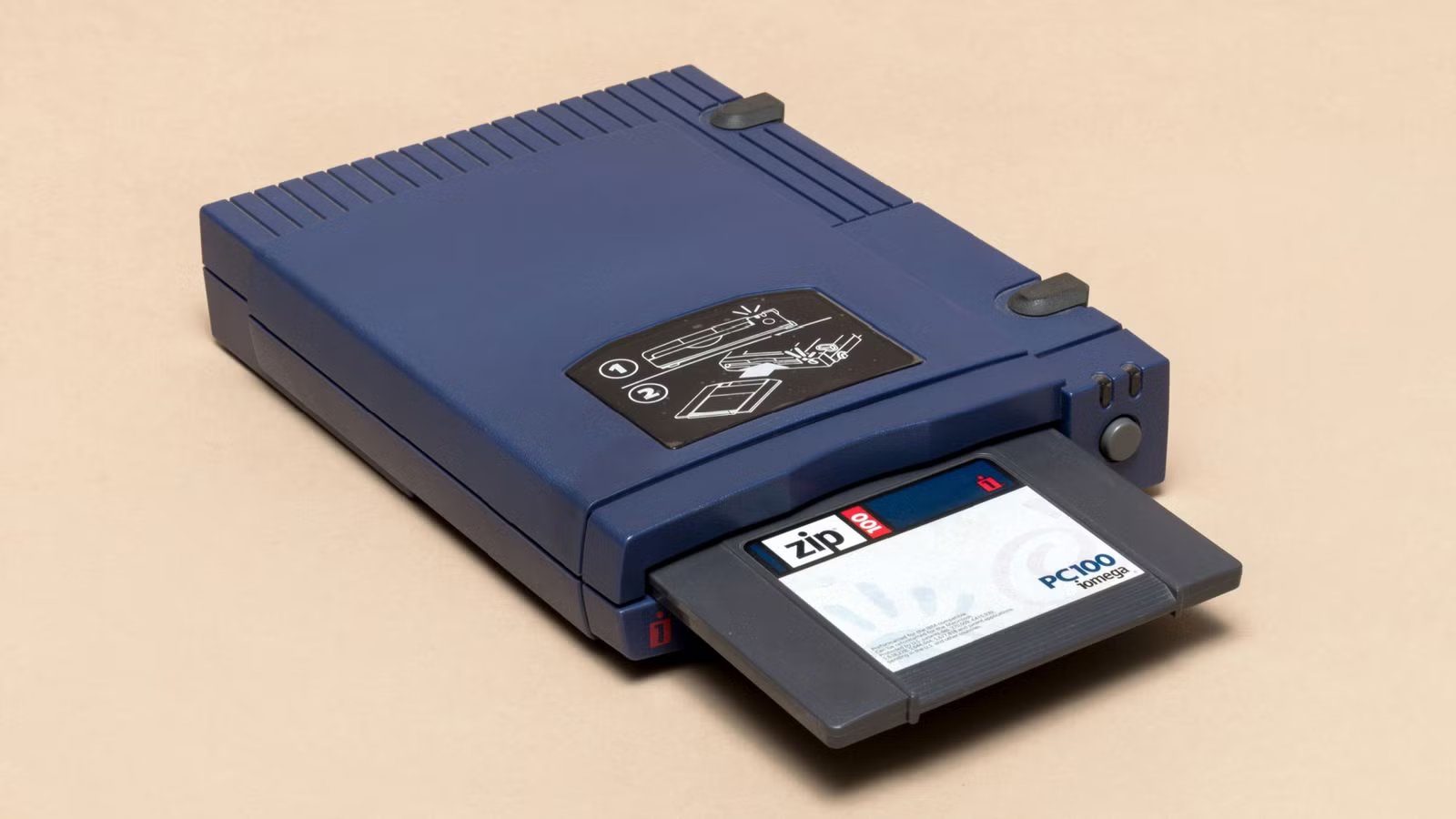
Kids today will never know the tyranny of the 1.44MB floppy disk. So traumatic was this format that today the “save” icon in our apps still looks like it, even though no one has actually used it for several decades.
Yet, despite many pretenders to the throne, the floppy remained relevant right up to the advent of USB flash drives, and stayed relevant while read-only CDs were at their peak. Writable discs and flash memory ended the reign of the floppy, but it could have happened earlier with the Zip drive. If only this storage tech didn’t have a fatal flaw.
What Zip drives were supposed to be (and why they took off)
They were literally a big deal
I don’t exactly have fond memories of installing Windows 95 from dozens of floppy disks, or video games that came on six or seven floppies. Computer data sizes kept going, yet common floppies stayed at 1.44MB, although there were 2.88MB and even larger disks which never caught on.
So you have to understand how blown away I was when I opened the pages of my monthly computer magazine and saw an advert for a disk that looked like a floppy at first glance, but offered a whopping 100MB of storage! Keep in mind that our family computer had just been upgraded from an 80MB hard drive to one that had a few hundred megs of storage, so, in comparison, these removable disks were huge.
I remember showing my parents the advert and getting nothing but mild confusion in return. Having little money of my own, I never got to experience Zip drives when they were new.
Perhaps that might have been for the best, because these disks were aimed at business users and media professionals. CD burners were super-expensive, and you couldn’t yet rewrite the disks, and if you were working with massive images or 3D models, you needed space. Zip drives would get larger too, with 250MB and even 750MB coming along towards the end. That last size was aimed right at CD-RWs, but as history shows it didn’t work out.
The infamous “click of death” and why it happened
Trust is everything
There are many reasons why the Zip drive never replaced the floppy drive. It was too expensive, not enough people bought them, so file-sharing was an issue, and, of course, writable and re-writable CDs stole their thunder as soon as prices came down. However, another significant issue was reliability.
At some point, a Zip drive could start making a clicking noise because the read/write heads had become misaligned. This was the infamous “click of death.”
Zip disks quietly became data traps
Do you feel lucky?
Not only did this mean the drive was busted, but it could damage the Zip disk, leading to data loss. If that wasn’t bad enough, the issue was (very rarely according to Gibson Research) contagious! A drive could damage a disk, which would then damage the next drive it was inserted into.
In 1998 (as reported by CNET) Zip users filed a class action lawsuit against Iomega:
They say the damage, which makes the computer disks unreadable, is caused by bits of metal that get onto the disks, and a lubricant that decomposes and accumulates on the reading mechanism.
Consider what this meant. Even though Iomega said the problem affects less than one half of a percent of drives, it meant you had no idea if the drive you’re about to stick your disk in will destroy it, or if the disk itself was a poison that could kill the drive.
Zip disks were data traps for other reasons too. Since they were magnetic, it meant that the data wouldn’t last as long as, for example, optical disc backups. But, a larger worry was that no one would have the hardware necessary to read Zip disks eventually, given it was proprietary and niche.
Zip drives are a modern archivist’s nightmare
Why won’t it read?
Credit: Alan Levine / Wikimedia Commons
It’s not hard to imagine that there’s interesting data from the 90s trapped on Zip disks that can never be recovered. Photos, source code for software, documents, the list goes on. Because of the click of death and its contagious nature, any archivist given a stack of Zip disks to preserve might end up destroying either the data or the hardware (or both) through no fault of their own.
Libraries and large organizations working through archives from the ’90s with the intention of preserving them in the cloud or on better modern long-term archival formats are going to encounter Zip disks, and they are going to be a pain to deal with.
The harsh lessons from the Zip drive era
Is history doomed to repeat?
There are lots of lessons to be learned from the Zip drive. People trusted it because it was more convenient and higher capacity, but these things don’t make a medium reliable. So maybe we’re abandoning optical media too quickly. After all, people are only now getting to grips with bit rot in SSDs.
At the very least, it should make you more keen to apply the 3-2-1- backup rule.
