

With all due respect to the Chevrolet Corvette, no vehicle is more deeply woven into the American identity than the Ford pickup truck. The F-Series has been the best-selling truck in the country for nearly half a century, and the best-selling vehicle of any kind for 44 years straight.
In 2025 alone, Ford moved over 800,000 of them: more than one sold every single minute of every day. That legacy stretches back to July 27th, 1917, when Ford debuted the Model TT. It’s a heritage the company wears proudly. Since 2021, every Ford F-150 dashboard has featured small metal American flags at each end.
Given all that history and patriotism, you’d expect the U.S. to receive every Ford truck model ever made. But that’s not the case. Some of the coolest Ford trucks ever built were never officially sold on American soil.
The reasons vary, but often foreign-market models use components that don’t meet U.S. safety or emissions standards, and buyer preferences play a role, too. Americans generally want bigger, more powerful trucks than their European counterparts. Whatever the reason, we don’t always get the best of what Ford has to offer.
These five trucks were never sold in the U.S., but this isn’t a complete list. Honorable mentions include the Ford Ranger MS-RT, Ranger Super Duty, and a few others.
Still, the trucks we highlight here might be the most surprising to never hit American soil. Don’t feel too bad for us, though. The F-150 and Super Duty aren’t officially sold in Europe, and the Raptor R more than makes up for missing out on these other Ford trucks.
5
Ford Falcon Ute (Australia)
An Australian icon for over half a century
The legacy of the Ford Ute in Australia stretches back to 1934. Legend has it that the wife of an Australian farmer asked Ford to build a vehicle that could take the family to church on Sunday and the pigs to market on Monday. The result was the Ford Model 40, the world’s first “coupe utility” vehicle, as it was effectively a coupe with a bed.
In 1961, Ford introduced the utility (or Ute) variant the Falcon XK sedan, and an icon (and a battle with Holden) was born. The Falcon Ute enjoyed a 55-year run Down Under, and nearly half a million were sold during that period.
The first generation, known as the XK series, was based on the Falcon Ranchero sold in the U.S. at the time. The Australian version featured a shorter rear overhang to more easily handle tough Australian roads and trails. The XR series debuted in 1966 and featured the first V8 engine for the model.
Starting in 1972, the Falcon Ute was designed, developed, and built entirely in Australia. That would remain the case until 2016, when Falcon Ute production in Australia ended. It was replaced by the Ford Ranger.
The Falcon Ute may no longer roll off Australian assembly lines, but its legacy is unmistakable. Born from a simple request for a versatile farm-and-family vehicle, it grew into an icon that defined Australian motoring for over half a century. Today, the Ford Ranger carries the torch, but for many Aussies, nothing will ever quite replace the original Falcon Ute.
Related
Even Toyota fans can’t deny the Ford F-150 is unbeatable
As America’s top pickup, the Ford F-150 sets the standard—and it’s time everyone takes notice.
4
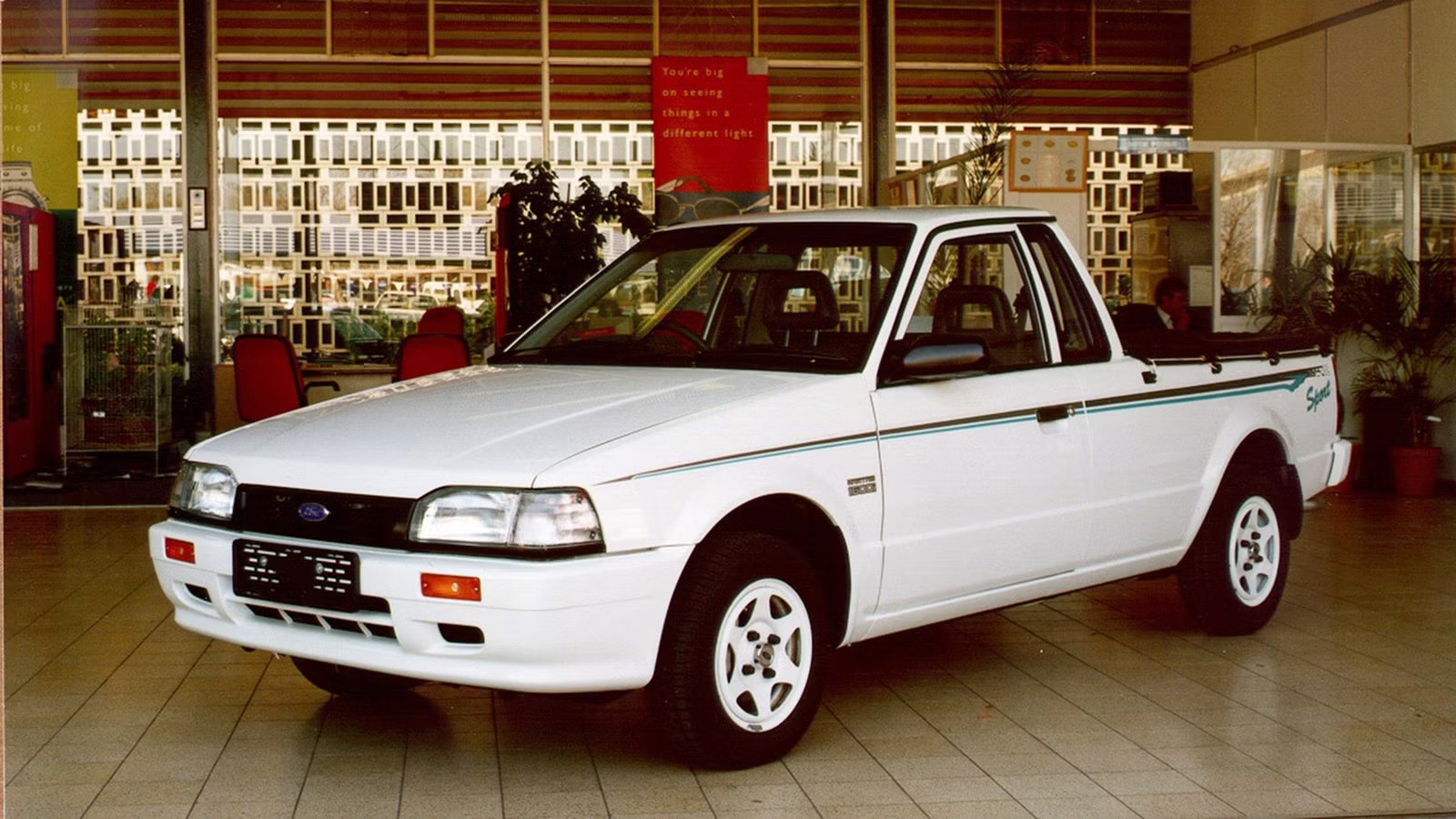
Ford Bantam (South Africa)
The Ford Bantam proved that bigger isn’t always better
In the world of rugged trucks, bigger is usually seen as better. But in South Africa, a small, car-derived pickup carved out a legacy that rivaled any full-sized 4×4. This is the story of the Ford Bantam, the “bakkie” that redefined the half-ton segment for nearly three decades.
Launched in 1983, while the rest of the world saw the Ford Escort as a simple family hatchback, South African engineers saw a workhorse. By grafting a reinforced load box onto the front of an Escort, they created a vehicle that was car-like to drive but tough enough to haul building supplies or farm produce.
What made the Bantam special wasn’t just its utility; it was its personality. It was the first vehicle for thousands of young drivers and the backbone of countless small businesses. When production ended in 2011, it left a void in the market that hasn’t quite been filled.
3
Ford Pampa (Brazil)
The compact truck that was perfect for city streets
The Brazilian market got a couple of cool Ford trucks that were off-limits to Americans, and one of them is the Pampa.
Like many Ford trucks sold outside of the American market, the Pampa was compact and efficient. It was built in Brazil between 1982 and 1997, and was based on the Ford Corcel. The Pampa was quite popular and became the best-selling car-based pickup in Brazil for several years.
The Ford Pampa is one of those forgotten workhorses that perfectly captures how automakers adapt to local markets. With a front-wheel drive unibody construction and a compact cargo bed, it wasn’t trying to be a brute. Instead, it was built to be useful and practical. With a payload capacity of 1,367 lbs., the Pampa became a go-to solution for both city streets and rural backroads across Brazil.
While a 4×4 variant introduced in the mid-1980s gave it surprising off-road credibility for such a small pickup, most buyers stuck with the more affordable front-wheel drive version, but the option alone helped cement its reputation as a capable all-rounder. We never got the Pampa here in the U.S., but we did get the Maverick, and that truck follows a similar recipe that made the Pampa a success.
What’s Included
M12 impact driver, hammer drill, 3/8-inch ratchet, charger, two batteries
Warranty
5-year warranty on tools, up to 3-year warranty on batteries.
If you’re looking for a great DIY starter kit from Milwaukee, this M12 3-tool combo kit is it. With an impact driver, hammer drill, and 3/8-inch ratchet, along with a 4Ah and 2Ah battery, this kit is a great starting point for projects both at home and on your vehicle.
2
Ford F-1000 (Brazil)
A heavy-duty truck that spawned several wild aftermarket creations
Not all non-American market Ford pickups are tiny compacts. For instance, take a look at the Ford F-1000 from Brazil (I didn’t fall asleep on the “0” key. This model really is called the F-1000).
It was basically a fifth-generation Ford F-250 adapted for the Brazilian market. The fifth-generation F-250 went out of production in the U.S. in 1972, but the F-1000 didn’t arrive in Brazil until 1979. So, it wasn’t exactly the freshest design, but that didn’t matter.
The F-1000 was offered only in a regular cab configuration, with rear-wheel drive being the only available drivetrain. Power to the rear wheels was generated via a range of engine options. There was everything from a 272-cubic-inch V8, a 3.4-liter inline-six, a 2.3-liter four-cylinder, and even a couple of diesel engines thrown in for good measure.
Later on, the F-1000 would see a second revival through Sulamericana, a Brazilian coachbuilder that created a number of wild F-1000-based variants, including the GB Monaco, Mirage, and GB Fly.
1
First-Gen Ford Ranger Raptor (Global)
The one Raptor we didn’t get
American enthusiasts got their first taste of Raptor madness back in 2010 with the Ford F-150 SVT Raptor, a truck that completely rewrote the off-road performance playbook. But while the U.S. enjoyed full-size desert domination, the rest of the world got something we didn’t: the original Ford Ranger Raptor.
From 2018 to 2022, it carved out a reputation overseas while we were stuck watching from the sidelines. By the time the second-gen Ranger Raptor finally hit U.S. shores in 2024, it almost felt like a consolation prize, and a reminder of what we missed.
Developed by Ford Performance, the first-gen Ranger Raptor was a big deal. It was the first factory-built high-performance midsize pickup in Europe, designed with a reinforced chassis, a unique suspension setup, and a punchy bi-turbo diesel engine. More than just a trim level, it was a true halo truck, built to elevate the Ranger’s reputation and prove that serious off-road performance didn’t have to come in full-size form.
Visually, it looked the part. A bold grille with oversized FORD lettering, flared fenders, and long-travel suspension gave it an unmistakable Baja-inspired stance. With nearly 11 inches of ground clearance and a wider track than the standard Ranger, it was built to take a beating. It rode on 17-inch wheels wrapped in all-terrain rubber, while practical touches like side steps and a functional cargo bed kept it grounded in real-world usability.
Under the hood, a 2.0-liter bi-turbo diesel paired with a 10-speed automatic sent power to all four wheels, supported by Fox suspension and multiple terrain modes, including Baja, for high-speed off-road driving.
We Don’t Get Everything
Credit: Ford
For a country that lives and breathes trucks, it’s surprising how many great ones we’ve missed. From the hardworking Falcon Ute to the clever Pampa and the Ranger Raptor, these machines prove that Ford’s truck legacy isn’t just American, it’s global.
Different markets demanded different solutions, and in many cases, that led to some seriously cool innovations. We may not have gotten them here, but their influence is clear. And if nothing else, they remind us that even the most truck-obsessed nation doesn’t always get the full lineup.
