

ESP32 microcontrollers are the powerhouses of DIY smart home projects. You can use them for everything from making a simple smart button to creating your own sensors. I recently bought a $30 ESP32 development board that’s completely changed my smart home.
Related
5 ESP32-powered 3D printing projects to try this weekend (Mar 27 – 29)
It’s all about filament and microcontrollers.
The reSpeaker Lite is a dual-mic array with an ESP32
Powerful on-board audio processing
Credit: Adam Davidson / How-To Geek
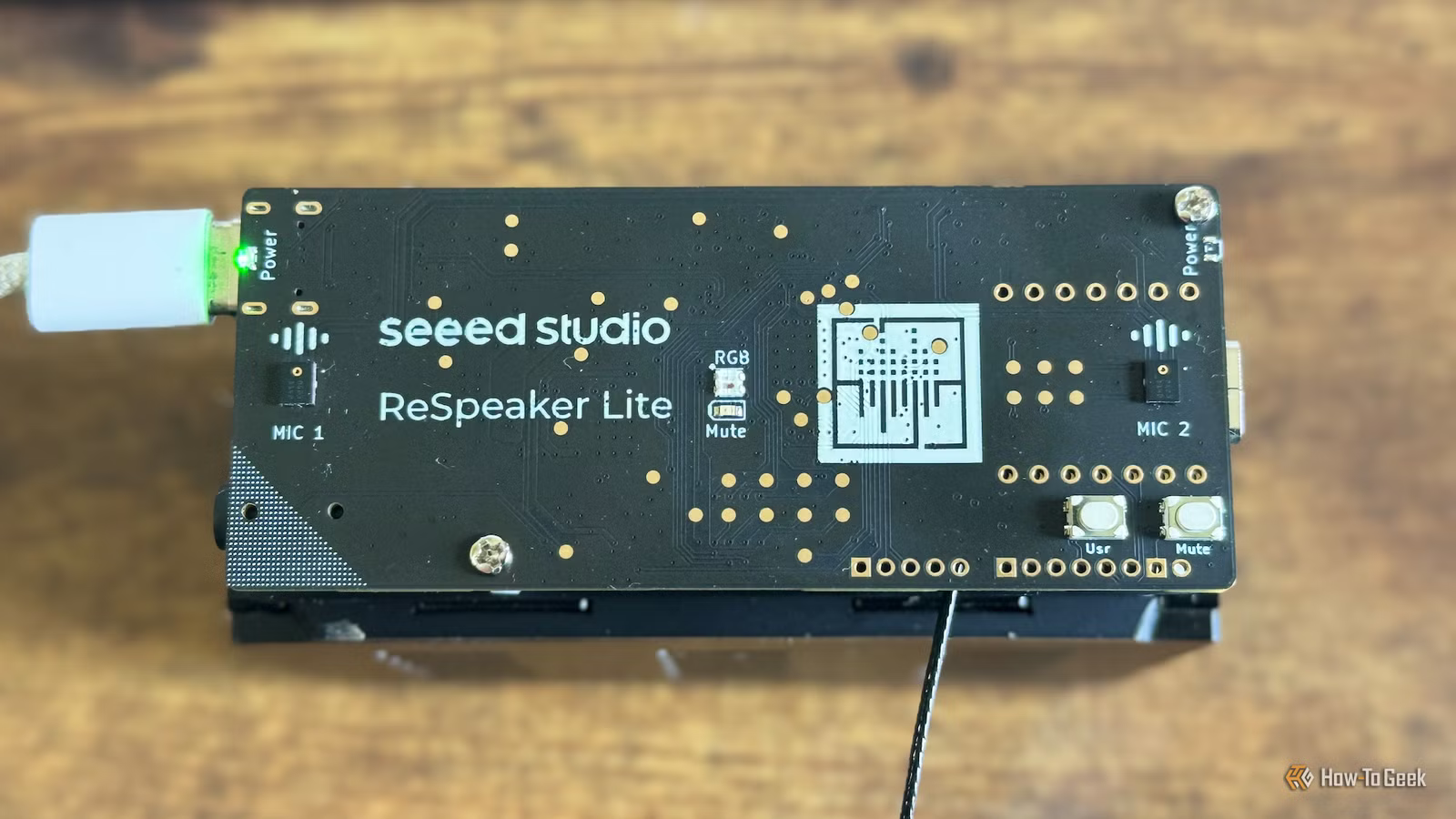
The Seeed Studio reSpeaker Lite is a development kit designed to act as an interface for local voice control. The audio is captured by a dual-microphone array that enables far-field voice capture so that it can pick up your voice from a distance, even when there is background noise.
The board features an XMOS XU316 audio processor that handles tasks such as noise suppression and acoustic echo cancellation (AEC), which help to isolate your voice from other background noise. The board also includes a XIAO ESP32-S3 microcontroller that has Wi-Fi and Bluetooth connectivity, allowing the processed audio to be sent to your local server, and audio to be sent back to the board to be played through connected speakers.
The board also includes an RGB LED that you can use to display different colors as an indicator of what action is currently taking place, and everything you need is either already on the board or can be plugged directly into it, so there’s no soldering required.
Brand
Seeed Studio
CPU
ESP32-S3R8
The reSpeaker Lite Voice Assistant Kit includes a two-mic array, a pre-soldered XIAO ESP32-S3 controller, and an XMOS XU316 audio processor with onboard natural language understanding, interference cancellation, acoustic echo cancellation, noise suppression, and automatic gain control. Hooked up a 5W speaker, you can create your own local voice assistant that you can connect to Home Assistant via ESPHome.
What the reSpeaker Lite enables
Free yourself from proprietary smart speakers
Credit: Adam Davidson / How-To Geek
The reSpeaker Lite was designed as a voice assistant development kit. It includes almost everything you need to start building your own smart speaker that can replace the likes of an Amazon Echo. The only other equipment you need to get your own smart speaker up and running is a 5W speaker and a USB-C power brick.
Building your own smart speaker can be challenging because it needs to be able to detect your voice even in noisy environments and be able to recognize the specific wake word (such as “Alexa”) that indicates you’re trying to talk to the smart speaker. The XMOS chip on the reSpeaker Lite makes this possible by handling all the audio work. For example, the AEC removes any audio that the speaker is playing from what the microphones are hearing, so that if the speaker is playing music, this doesn’t drown out your commands.
There are also features such as noise suppression that remove non-human background noise from the input audio, and automatic gain control that adjusts the level of your voice. It means that whether you’re shouting close to the mic or whispering several feet away, the audio is the ideal level for voice recognition.
The upshot is that using the reSpeaker Lite, you can build a smart speaker that can work well enough to allow you to ditch your proprietary smart speakers. You can then replace them with local models that respect your privacy and don’t rely on the cloud.
It’s easy to connect to Home Assistant
ESPHome for the win
The reality is that you can’t just buy a reSpeaker Lite, plug it in, sign in to an account, and have it control your smart home like you can with options such as Alexa smart speakers or Google Home. These systems rely on processes that take place on cloud servers. You need some brains to replace these cloud services, and that’s where Home Assistant comes in.
Home Assistant is free, open-source smart home software that works with an enormous range of smart home devices and offers powerful automation features. You can combine your DIY smart speaker with Home Assistant via ESPHome to create a system that can do many of the things that proprietary smart speakers can do. The reSpeaker Lite listens for the wake word, hears your command, and passes it to Home Assistant to handle.
By default, the native Assist voice assistant in Home Assistant is fairly basic. It has a limited set of commands that you can use to control your smart home, such as turning lights on and off or playing music. You can use these commands to control your smart home with your voice using the reSpeaker Lite, just like with a proprietary smart speaker.
What Assist can’t do out of the box is things such as answering questions or understanding natural language like an Echo or Google Home smart speaker can. However, you can hook up Assist to an LLM service such as OpenAI and make it much smarter.
The experience is comparable to other smart speakers
Wake word detection is good, and the response is fast
Credit: Adam Davidson / How-To Geek
There are two things a good smart speaker needs to be able to do. It needs to be able to accurately detect the wake word and hear your commands, and it needs to be able to respond without too much of a painful delay.
The reSpeaker Lite does both of these things. It can pick up the wake word in my home office even when I have music playing on my hi-fi speakers, which are right next to it. It understands my commands clearly, and the response is fast. If I ask it to turn the light off, for example, it happens in about a second, which is plenty fast enough for my needs.
Hooking it up to an LLM also gives it understanding that’s better than the default abilities of most smart speakers. For example, if I ask Alexa for the men’s 100-meter world record, it can tell me the answer. If I follow up by asking, “What about the 200?” Alexa tries to open an unrelated skill, having completely failed to understand that this query is related to the previous one.
With the help of an LLM, my reSpeaker Lite smart speaker not only answers the first question accurately, but also correctly understands my intent and gives me the men’s world record for the 200 meters. Thanks to this $30 ESP32 board, I now have a smart speaker that can control my devices locally, and for my needs, it can work as well as my Echo smart speakers.
A smart local smart speaker needs a local LLM
Connecting a local smart speaker to an external LLM partially defeats the purpose of a local smart speaker, as it sends information about your smart home to a third-party service in the cloud. However, if you have a computer with a reasonable GPU, you can host your own local LLM as the brains, to make your smart speaker smarter with none of your information leaving your home network.
