

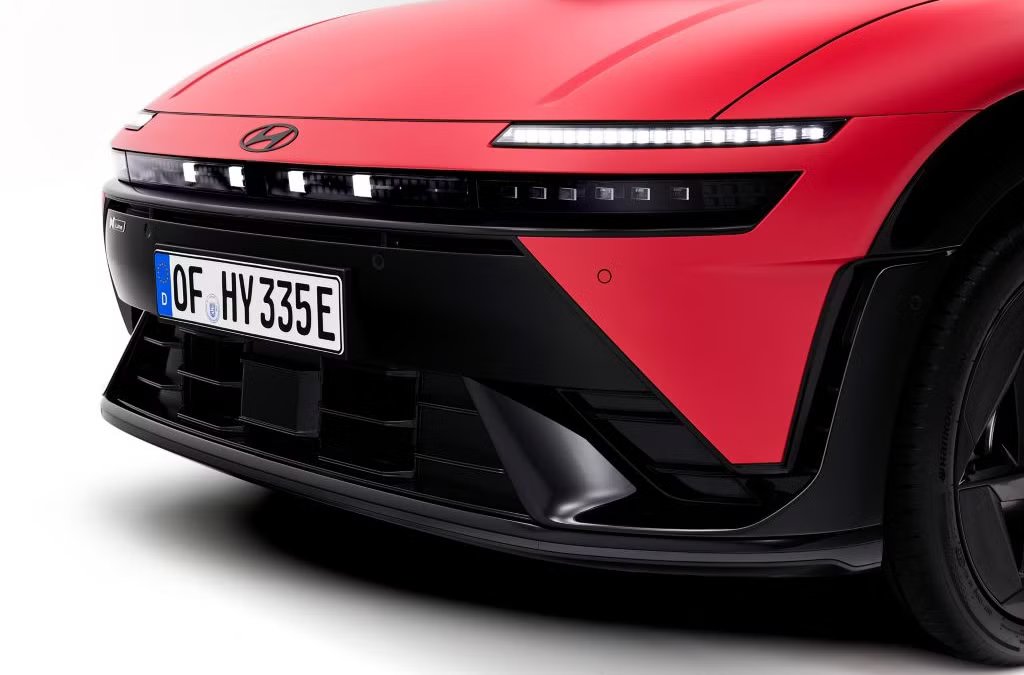
Hyundai has revealed the newest member of its electric family, the IONIQ 3. Unveiled in Milan, the fully electric compact hatch is designed specifically for the European market. While its larger siblings, the IONIQ 5 and IONIQ 6, grabbed headlines for their retro-futurism and streamlined silhouettes, the IONIQ 3 introduces what Hyundai calls the Aero Hatch typology.
Or put another way, it’s a design meant to solve an age-old hatchback dilemma: achieve excellent aerodynamics without sacrificing rear headroom and cargo space.
While the IONIQ 3 is being positioned as a pragmatic solution for European EV buyers, its absence from North American showrooms feels like a missed opportunity for a market in need of more vehicles like it. There is a continued sense that more right-sized and right-priced EVs like the IONIQ 3 could make widespread adoption of electrified vehicles possible.
However, the math for a potential North American launch remains complicated. Between a historical American preference for larger, more imposing SUVs and the hurdles of import tariffs on vehicles produced outside the United States, the IONIQ 3 will remain a sporty yet forbidden fruit for the foreseeable future.
Art of Steel design language
Morse code details
The IONIQ 3 is the first to showcase Hyundai’s Art of Steel design philosophy.
Although it sounds like a book about the history of Clark Kent, the Art of Steel design is defined by a low front end and a roofline that stays high over the passengers before dropping into a rear spoiler. The Art of Steel shape helps the IONIQ 3 achieve a drag coefficient of 0.263, impressive for any compact hatch.
True to the IONIQ brand, you’ll find the signature pixel lighting and a subtle Morse code detail with four central dots representing the letter “H” for Hyundai.
“Hyundai Motor America currently has no plans to offer the Ioniq 3. More broadly, we continually evaluate market trends and customer demand as part of our long-term product-planning strategy. We remain focused on developing and delivering vehicles that meet the needs of U.S. consumers. Should we have any news regarding future products or lineup expansion, we will share it through our official channels.” ~ Statement from Hyundai provided to How-To Geek’s sister publication, CarBuzz.
Living room on wheels
Provides a sanctuary between work and home
Despite its compact footprint (163.6 inches), the interior is surprisingly generous. Hyundai used its Electric-Global Modular Platform (E-GMP) to create a flat floor and a longer wheelbase, enabling what it calls a “furnished space” interior array.
Think of it less like a traditional car interior and more like a modern living area, or the idea that our vehicles now serve as “third spaces” between work and home. The materials are inspired by 1970s Italian furniture and use recycled and bio-based textiles.
Practicality hasn’t been forgotten, either; the trunk offers 15.6 cubic feet of capacity, including a Megabox (not a Superman villain) hidden under the floor for extra storage.
Related
Guardian angel tech from Hyundai and Kia aims to end school zone tragedies
Vision Pulse leverages the promises of V2X
Pleos Connect and Android Automotive OS
Display screens vary by trim level
The IONIQ 3 is the first European Hyundai to feature the Pleos Connect infotainment system. Built on Android Automotive OS, the system is designed to be intuitive and seamless. Depending on the trim level, drivers will interact with either a 12.9-inch or a 14.6-inch display.
Other notable tech features include:
- Digital Key 2: Can access the IONIQ 3 via a smartphone or a wearable device.
- Vehicle-to-Load (V2L): Uses the battery to power external devices, both inside and outside the vehicle.
- SmartSense Suite: Includes Hyundai’s Highway Driving Assist 2 system, remote smart parking, and a blind-spot monitor.
What’s Included
Windshield Mount
Radar Band Detection
X, K, Ka
The Uniden R8 is a dual-antenna radar detector with directional arrows, known for its long-range detection and false alert filtering capabilities. Comes preloaded with red light and speed camera locations and supports firmware updates for ongoing performance enhancements.
Standard and long range options
400-volt architecture supports DC fast charging
Credit: Hyundai
Hyundai is offering two battery options to fit different lifestyles:
- Standard Range: 42.2 kWh battery with a projected WLTP range of 214 miles.
- Long Range: 61 kWh battery targeting 308 miles.
The front-wheel drive motor produces up to 107.8 kW, which translates to roughly 147 horsepower.
When it comes to charging, the IONIQ 3 uses a 400-volt architecture. While not the ultra-fast 800-volt system found in the IONIQ 5, it still supports DC fast charging that can take the battery from 10 to 80 percent in about 29 minutes. For home or destination charging, it supports up to 22 kW AC charging.
Designed and built for Europe
The IONIQ 3 is a local effort, designed in Europe and produced at Hyundai’s plant in İzmit, Türkiye. It’s a key part of Hyundai’s goal to electrify its entire European lineup by 2027.
With its blend of Italian-inspired interior design, practical hatchback layout, and the latest Android-based software, the IONIQ 3 looks like a strong option for those ready to make the jump to an EV in Europe.
