

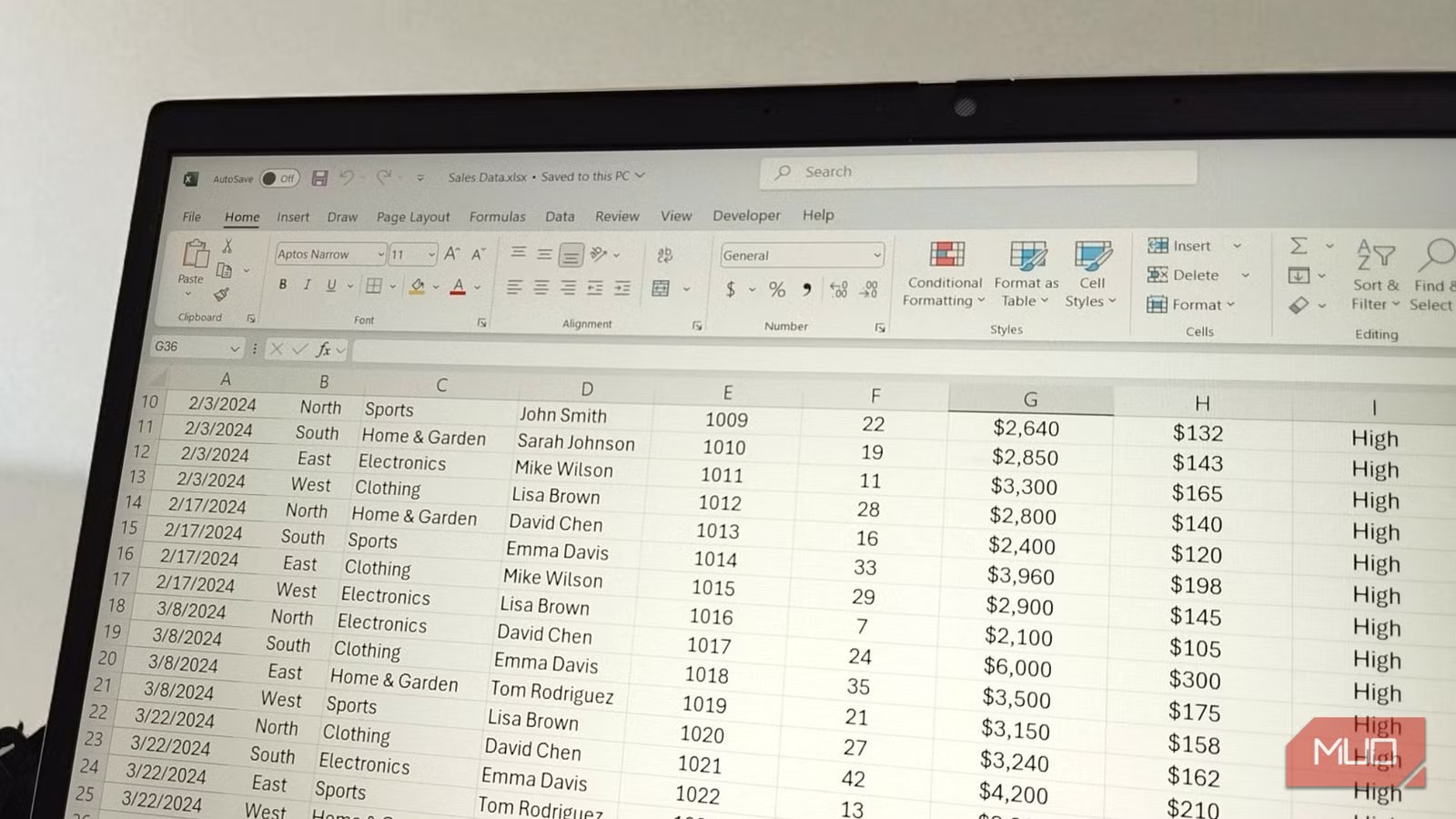
I used to set aside time every week to clean my spreadsheets by running helper formulas, scanning for red cells from conditional formatting, and fixing typos that had snuck in over the past few days. The cleanup never got shorter, so I gave Excel’s Data Validation dialog a closer look. Instead of finding mistakes after they’d already poisoned my pivot tables, I now block them the moment someone tries to enter an invalid value.
Related
Excel’s dynamic array functions made me realize I’d been solving problems the hard way for years
Turns out half my old formulas were just dynamic arrays in disguise, written the long way.
Data validation blocks the bad entry instead of finding it later
The whole setup takes about 30 seconds per rule
Screenshot by Yasir Mahmood
My old setup wasn’t broken, exactly. I had a column of IF and COUNTIF formulas running quietly next to my data, plus conditional formatting rules that turned cells red when something looked off. Every Friday, I’d scroll through and fix what lit up. The trouble is that this approach is reactive — by the time I caught a typo, it had already broken a SUMIFS or split a category in my pivot table.
Data Validation flips that order. It lives under the Data tab, and the basic idea is straightforward: you tell Excel exactly what’s allowed in a cell or range, and Excel refuses anything else. To set up a rule:
- Select the range you want to protect.
- Go to Data > Data Validation.
- Pick a rule type from the Allow dropdown, e.g., whole numbers, decimals, dates, time, text length, list, or custom.
- Set the parameters (a minimum and maximum, a source list, or a formula).
- Click OK.
In my sales sheet, I used a whole-number rule on the Units Sold column to enforce a range between 1 and 100. Actual values in that column run from 7 to 44, so 100 leaves room without letting in something nonsensical like 1,500 from a mistyped entry. That rule alone catches the kind of mistake I’d otherwise need a helper formula and a red highlight to find.
Dropdown lists eliminated my biggest source of typos
One source list, zero misspellings across the entire sheet
This is the section of Data Validation I lean on most, and it’s the one I wish I’d built into my workflow earlier. My sales spreadsheet has a Product Category column, and before I added a list rule, the same column held “Electronics,” “ELECTRONICS,” and “electronics” as three separate values. “Home & Garden” and “Home and Garden” were also splitting the same category in two.
When I built a pivot table from that data, I got duplicate rows for what should have been one product line. Here’s how I fixed it:
- Set up a small range elsewhere on the sheet with the four allowed values: Electronics, Clothing, Home & Garden, and Sports.
- Select the Product Category column.
- Go to Data > Data Validation > Allow > List.
- Set the Source to that range (or convert it into an Excel table and reference it as a named range so the dropdown grows when I add a new category).
- Click OK.
Now every cell in that column shows a small arrow, and entries are limited to those four options. The pivot table cleaned itself up the next time I refreshed it.
Pointing the source at an Excel table beats typing values directly into the validation dialog, because you can add or remove categories in one place and every dropdown updates automatically.
Custom formulas enforce rules that the built-in options can’t
A single formula can stop duplicates, enforce formats, or catch logic errors
Screenshot by Yasir Mahmood
The Custom option in Data Validation is where the feature gets genuinely useful for messier rules. You write a formula that returns TRUE for valid entries and FALSE for everything else, and Excel does the rest.
Three rules I find myself using often:
- Block duplicate entries. For an order ID column, =COUNTIF($E$2:$E$1000,E2)=1 stops anyone from logging the same ID twice. That’s much cleaner than running a duplicate check after the fact.
- Enforce a format. If product codes in your sheet should always start with “PRD-,” =LEFT(A2,4)=”PRD-” rejects anything that doesn’t. Useful for keeping code consistent across collaborators.
- Catch logical errors. If column B holds an end date and column A holds a start date, =B2>=A2 blocks entries where someone enters a project end date that’s earlier than the start.
The trade-off is worth flagging. Custom formulas only return a pass or fail — Excel won’t tell the user why their entry was rejected, which is where the next section comes in.
Keep custom formulas simple. Anything you can read at a glance is easier to debug a year from now when you’ve forgotten why you set the rule up in the first place.
Input messages and error alerts make the rules obvious
A clear prompt beats a silent failure every time
Screenshot by Yasir Mahmood
The Data Validation dialog has two other equally important tabs: Input Message and Error Alert. They’re what turn a silent rule into something a collaborator can actually work with.
The Input Message tab adds a small tooltip that pops up when someone selects the cell. I use it to explain what’s expected before anyone starts typing — something like “Enter a value between 1 and 100” or “Pick a category from the dropdown.” It doesn’t block anything; it just answers the question someone would otherwise have to ask me.
The Error Alert tab is more interesting because it gives you three styles to choose from:
- Stop rejects the entry entirely. Best for hard rules, like unique IDs or category labels.
- Warning asks the user to confirm before accepting the value. Good for soft rules, say, a discount of over 30% that’s allowed but unusual.
- Information just notifies the user and accepts the entry anyway.
The other thing worth doing here is writing useful alert text. Excel’s default message is “This value doesn’t match the data validation restrictions defined for this cell,” which tells nobody anything. However, “Please enter a date after the project start date” is more clarifying and actually helps.
Where I’m taking my validation rules next
Layering validation on top of dynamic arrays is the next step
Data validation isn’t a complete replacement for conditional formatting — there’s still a place for highlighting outliers that fall within the rules but look unusual. What it changes is the order of operations. The next thing I want to try is pairing validation rules with dynamic array formulas, so my source lists for dropdowns expand on their own as I add new categories or salespeople.
