

The Tesla Model Y has become the benchmark in the EV SUV space, and for good reason. It consistently leads sales and sets expectations for range, technology, and everyday usability.
It’s also the default choice for a lot of buyers in this segment, with few mainstream rivals managing to meaningfully disrupt its position so far. But that doesn’t mean the competition is standing still.
I recently drove a new EV SUV that immediately challenged that benchmark. From the moment I got inside, it felt more spacious and more luxurious than the Model Y, with a level of cabin comfort that stood out straight away.
Related
I didn’t expect a compact SUV to feel this luxurious
The Changan Deepal S05 is a surprisingly polished compact SUV with comfy seats, clever tech, and enough power for everyday driving fun.
Where the AION V EV SUV comes from and who builds it
What you need to know about its parent company
Credit: Adam Gray | How-To Geek
Here in the UK, a growing number of Chinese automakers are entering the EV market with increasingly competitive offerings. The AION V is produced by GAC Group, a major state-owned Chinese automaker.
AION has also grown quickly within that ecosystem and is frequently ranked among the world’s largest EV producers, alongside Tesla and BYD.
Related
These Are the High-Tech Chinese EVs the U.S. Is Missing Out On
China is producing some truly impressive EVs that, for now, won’t be making their way to the U.S. market.
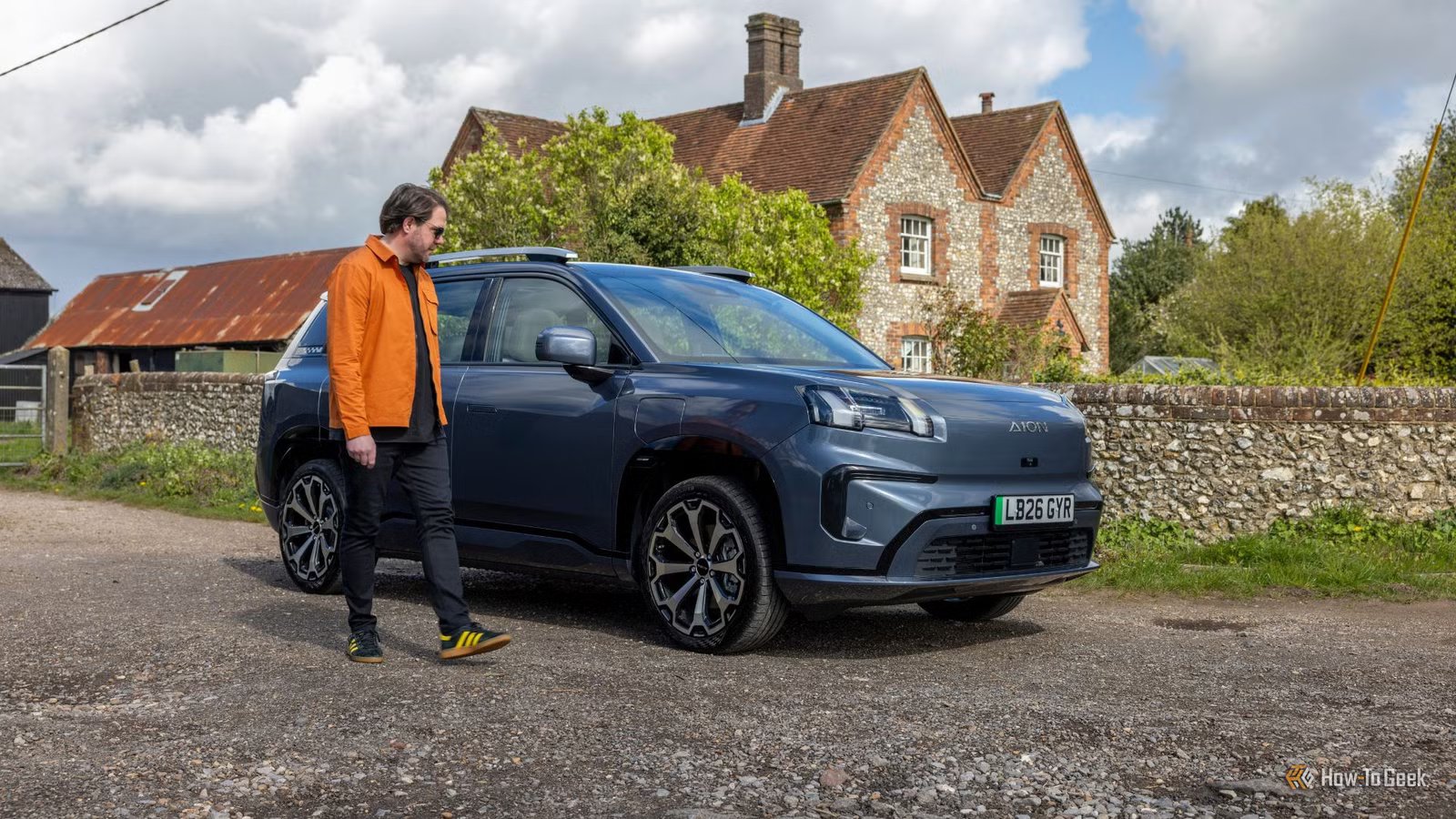
A look at the AION V EV SUV’s exterior styling
Early thoughts on its proportions and road presence
As someone who gets to test a range of the latest Chinese EVs, one thing has become increasingly clear. If you removed the badges, it would often be difficult to tell which brand you’re looking at, as many share a broadly similar design language.
It’s also not always immediately clear which segment they sit in—crossover, mid-size SUV, or something in between. The AION V, however, does begin to separate itself from that pattern.
The front end keeps things minimal, with a smooth, grille-less panel where you would typically expect a combustion-style design. Four-line LED daytime running lights add definition, echoed by the taillights at the rear.
The AION V is a large, chunky SUV, and if anything, the standard 19-inch alloys feel slightly undersized in proportion. However, the pronounced wheel arches and roof rails help reinforce its SUV stance and give it a more purposeful road presence.
Related
This affordable electric SUV rivals much pricier cars
This affordable electric SUV offers premium comfort, generous tech, and an 8-year warranty without the premium price.
Inside the AION V and its interior design
A focus on space, materials, and layout
Much as you might expect from most modern EVs, the AION V’s cabin is dominated by a large central touchscreen, supported by a slim driver display. Beneath it are two storage slots for your phone, one of which offers wireless charging.
Where the AION V really surprised me, however, is just how spacious it is inside. There is a huge amount of room in the rear, with six-foot passengers getting generous leg and headroom, along with a wide fold-down center armrest.
If you want to step things up, the Premium Pack adds tray tables in the rear, similar in concept to those you might find in a Bentley Flying Spur. They are clearly aimed at working on the move, assuming you have someone else doing the driving.
Credit: Adam Gray | How-To Geek
The touchscreen itself is bright, sharp, and responsive, but not without its frustrations. Too many functions are buried in layered menus with inconsistent naming, which makes them harder to access than they should be.
Storage isn’t one of the AION V’s strongest areas. There’s no traditional glovebox, although you do get a central armrest compartment and, on Premium Pack models, a temperature-controlled storage box for keeping food or drinks hot or cold.
Overall, the AION V feels solidly built with interior materials that, in my view, feel more premium than many similarly priced rivals. Premium Pack models also add real leather upholstery instead of the synthetic alternatives commonly found in newer EVs, including the Model Y.
Credit: Adam Gray | How-To Geek
To keep things simple, there is only one battery and motor combination available. There are no traditional trim levels as such, although the £1,450 (~$1,974) Premium Pack that adds a significant amount of extra equipment.
As standard, the AION V comes well-equipped with power-adjustable front seats that are both heated and ventilated, a heated steering wheel, 19-inch alloy wheels, full LED lighting, a panoramic roof, wireless phone connectivity, vehicle-to-load functionality, dual-zone climate control, and a 360-degree camera system.
Opting for the Premium Pack adds a more luxury-focused interior experience. This includes genuine leather upholstery, massaging front seats, rear tray tables, and a temperature-controlled storage compartment. It also brings an air quality sensor, along with the option of cream or tan interior trims in addition to the standard black finish.
Related
The Korean SUV that’s making BMW and Audi owners question their choices
This SUV makes traditional luxury pricing hard to justify.
How the AION V drives on the road
Comfort, refinement, and everyday usability
Credit: Adam Gray | How-To Geek
Despite its fairly chunky proportions, the AION V has clean, square dimensions and a low window line, which makes it relatively easy to place on the road in tight urban environments. It also comes with a 360-degree camera as standard, which makes parking straightforward.
The steering is light, and the electric motor responds quickly. While it deals well with larger bumps and potholes, smaller sharp imperfections can still cause noticeable cabin movement.
On paper, 204 horsepower doesn’t sound especially high by modern EV SUV standards, but in practice there is still plenty of performance for everyday driving. Merging onto faster roads or overtaking is handled with ease, and once up to speed, the AION V settles into a quiet and relaxed cruising character.
However, it’s a very different story when the road becomes more demanding. The AION V’s size becomes more noticeable in corners, where it can feel heavy if pushed. It is not a performance-focused SUV, and body lean is evident through bends, while the light steering offers limited feedback about what the front wheels are doing.
Related
Here’s How Much It Costs to Replace a Tesla Model Y Battery
Here’s how much you can expect to pay when the time comes to replace your Tesla Model Y’s battery.
The AION V’s real-world range and charging capability
Real-world efficiency and everyday usability
Credit: Adam Gray | How-To Geek
Powering the AION V is a 75.3kWh battery, with a claimed range of up to 317 miles. During my time with the vehicle, I saw efficiency of around 3.2 miles per kWh, though with a heavier driving style, 3.5 miles per kWh feels more realistic, which would translate to just over 260 miles of real-world range.
When it comes to charging, the AION V supports a maximum rate of 180kW. That allows it to charge from 10–80 percent in around 24 minutes, which is competitive enough for this segment and makes longer journeys fairly straightforward.
Related
The Ultimate Bang For Your Buck EV In 2025
This 2025 EV delivers top-tier range, tech, and performance at an unbeatable price, making it the best value choice in the electric market.
Final verdict on the AION V
Strong on comfort and space, less convincing on driving feel
Credit: Adam Gray | How-To Geek
Pros
Cons
- Extremely spacious interior
- Strong level of standard equipment
- High-spec premium experience (on upper trim)
- Underwhelming driving dynamics
- Frustrating infotainment system
- Minor but notable practicality quirks
To sum things up, the AION V offers a genuinely luxury-feeling interior and more than enough passenger space for everyday use. Starting at £36,450 (~$49,672), and with an eight-year care package included — covering warranty, servicing, and roadside assistance — it presents itself as a strong all-in ownership proposition.
However, it isn’t without its compromises. While comfort and space are clear strengths, the driving experience and software quirks may leave some buyers wanting more refinement in day-to-day use.
As a result, some may still be drawn to alternatives such as the Tesla Model Y, or upcoming rivals like the Kia EV3, expected to arrive later in 2026.
