

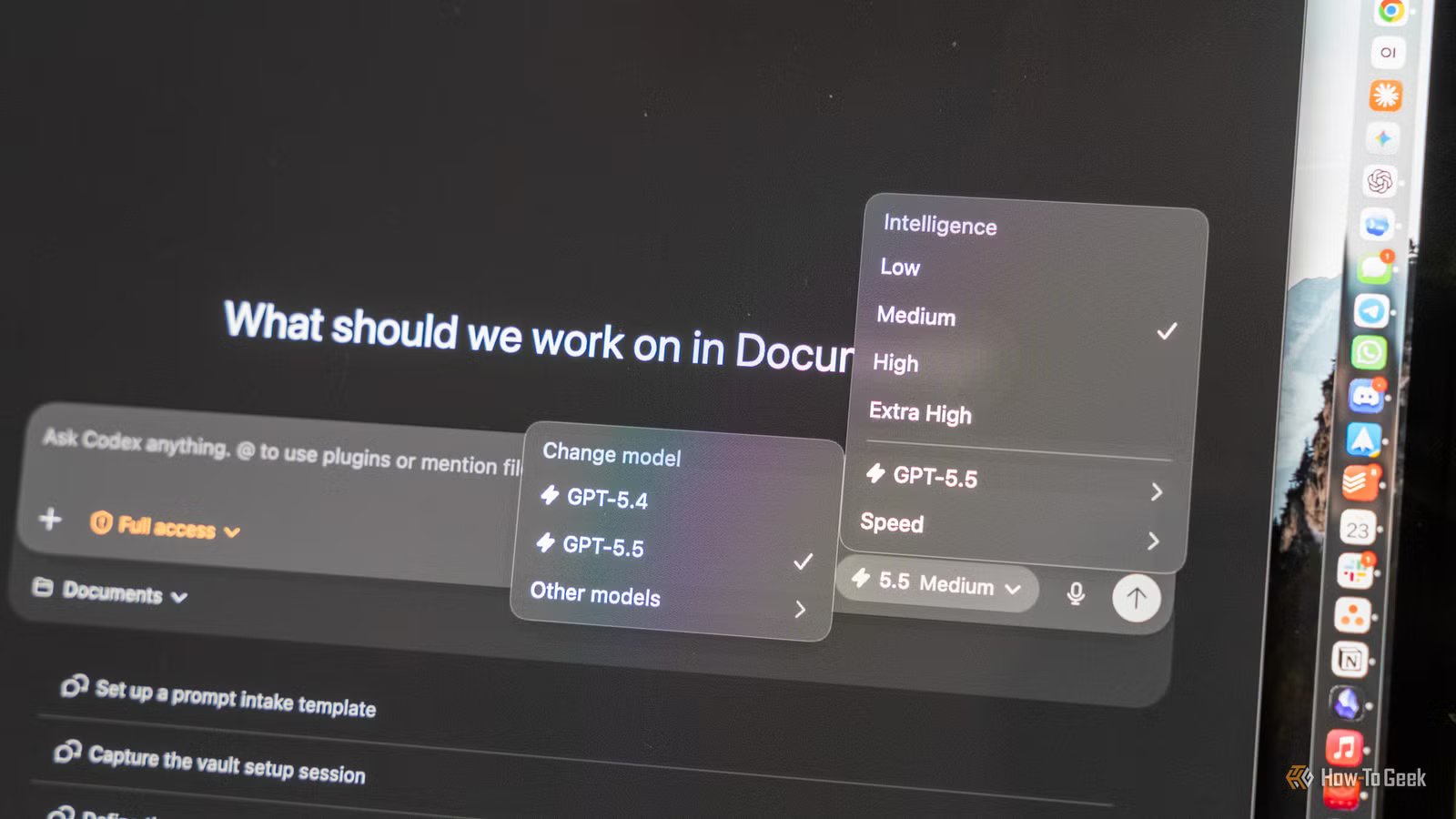
OpenAI is tackling the challenges of agentic AI head-on with the release of its GPT-5.5 model. While AI is no stranger to handling computer tasks, the company claims its new large language model (LLM) is better when dealing with “messy, multi-part” work where you need to trust that it will not only finish, but produce trustworthy results.
The newly available model is billed as OpenAI’s “strongest” yet for agentic coding. It reportedly beats GPT 5.4, Anthropic’s Opus 4.7, and Google’s Gemini 3.1 Pro when taking on programming that demands planning, coordinated tool use, and iterative work. It’s both more accurate and more likely to complete all tasks in a single pass, the company claims. In Codex, it’s said to be better at preserving context, double-checking assumptions, and reasoning its way through ambiguity in glitches.
Those same strengths also help GPT-5.5 with knowledge-related duties like scientific research and creating documents. OpenAI asserts that the updated LLM feels more like it can “use the computer with you,” taking precise actions while understanding your intent and verifying its output.
OpenAI also touts faster, more efficient computation, and is offering “tighter” security safeguards that do more to lock down sensitive data while lowering the barriers to access for cybersecuriy teams with verified users. The company warns that GPT-5.5 isn’t yet ready to handle critical biochemical and cybersecurity responsibilites under the firm’s own Preparedness Framework, but still finds that it’s superior to 5.4.
Pricing and availability for GPT-5.5
It’s initially aimed at paying customers
Credit: Patrick Campanale / How-To Geek
GPT-5.5 is available now in ChatGPT and Codex for Plus, Pro, Business, and Enterprise subscribers. GPT-5.5 Pro, meant for the most strenuous tasks, is reaching ChatGPT for Pro, Business, and Enterprise customers.
Codex users can rely on GPT-5.5 in Plus, Pro, Business, Enterprise, Edu, and Go tiers with a 400K context window. You can also use a Fast mode if you’re willing to pay more for quicker results. Developer access through the API will be available “very soon.”
Prices for the new model are typically twice as high as for GPT-5.4. It costs $5 to input 1 million tokens (versus $2.50), $30 to output the same volume (versus $15), and $0.50 for cached input (versus $0.25). OpenAI argues that 5.5 is more intelligent and “much more token efficient,” however, so you might not need to use as many tokens for the same job.
OpenAI takes on Anthropic, Google, and Microsoft
GPT-5.5 isn’t your only option for coding and research
The GPT-5.5 release comes at a prime moment. Anthropic is testing how developers would respond to removing Claude Code from its Pro plan, and that could steer programmers toward OpenAI’s offering.
Related
Claude vs. Gemini: Which one actually writes better code?
Gemini has a lot of promise, but Claude wins hands down.
There are also evolving options like Google Gemini Pro and Microsoft’s GitHub Copilot, each of which can have their own advantages. Gemini has a full integrated developer environment (IDE). GitHub’s popularity for code repositories gives it an edge, while Claude Code is well-known for its plugins.
OpenAI’s bet is that coders and researchers are more interested in raw performance, and are willing to pay for it. That may make GPT-5.5 compelling if you’ve had too many AI agents either quit mid-task or produce unreliable material.
