

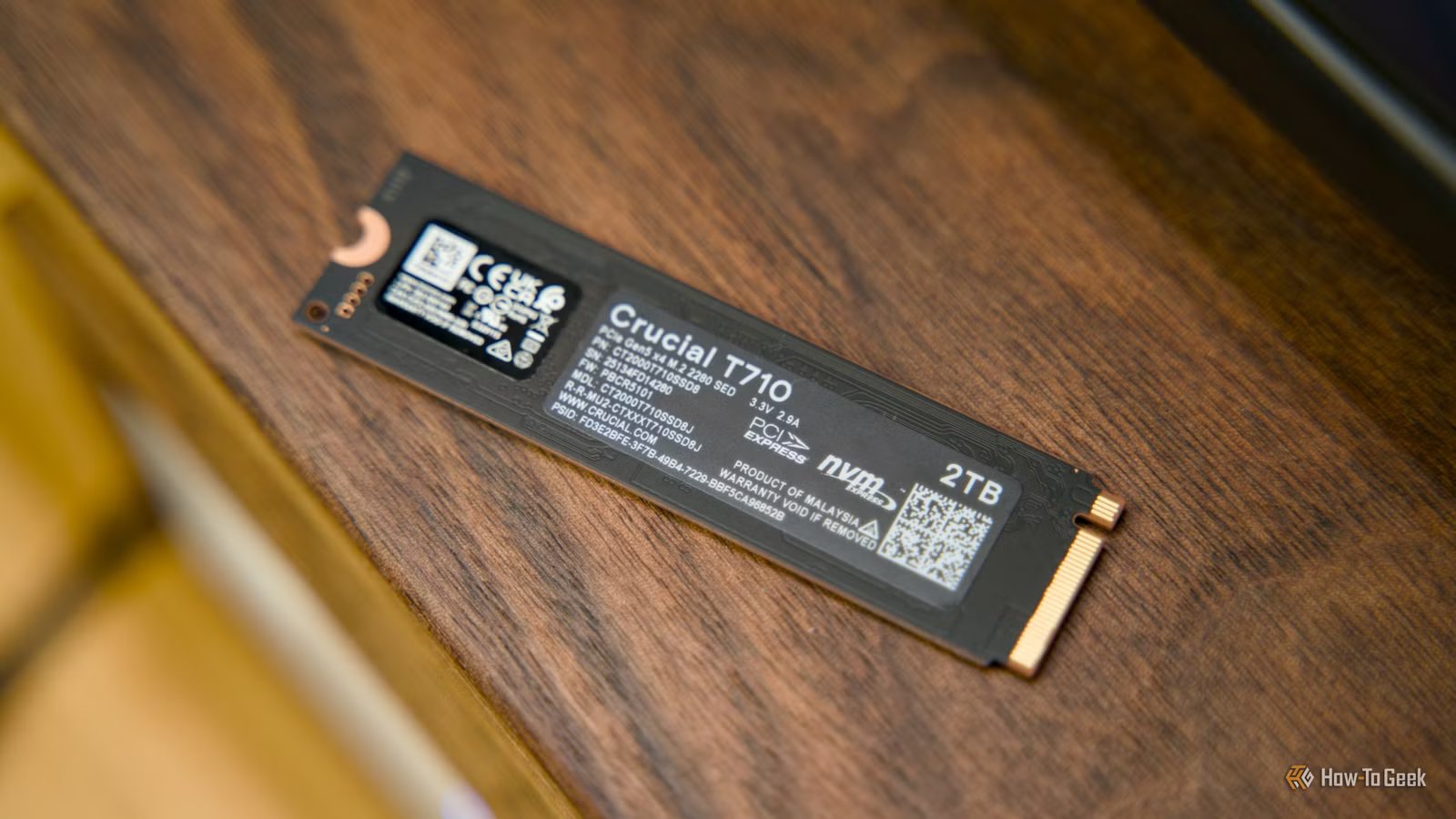
SSDs are hardly a new product in this day and age, and yet, they’re still the subject of many myths that should have died off around a decade ago. And honestly, that’s me being generous.
It’s interesting that SSDs continue to be so polarizing. Sure, they’re a mainstay in consumer electronics these days, to the point where I can’t imagine any device worth the money being sold without SSD storage, but even then, there are so many misconceptions around SSDs. Let’s clear them up.
Most SSD myths have no business existing in 2026
Some advice got stuck in the wrong decade
When SSDs first started showing up in consumer PCs, the number of misconceptions surrounding those new, ultra-fast drives was through the roof. I get it. Most people don’t love change, and when something is as expensive as a PC, you really just want to make sure you can trust it. I suspect that AIO coolers get a bad rap for that exact reason, too.
Once a rule gets passed around enough, people just take it at face value without wondering whether it only applied to older versions of the same hardware or whether it was ever true to begin with.
Quiz
8 Questions · Test Your Knowledge
Weird and quirky storage drives
Trivia challenge
From hybrid SSHDs to bizarre form factors — how well do you really know the oddest corners of storage technology?
Hybrid DrivesForm FactorsHistoryHardwareOddities
Begin
What does the acronym SSHD stand for in the context of hybrid storage drives?
ASolid State Hard DriveBSolid State Hybrid DriveCSequential Storage High-DensityDStatic Spinning Hard Disk
Correct! SSHD stands for Solid State Hybrid Drive. These drives combine a traditional spinning hard disk with a small amount of NAND flash memory to accelerate frequently accessed data, giving users a middle ground between HDD capacity and SSD-like speed.
Not quite — SSHD stands for Solid State Hybrid Drive. While ‘Solid State Hard Drive’ sounds convincing, it’s actually a common misconception. The ‘hybrid’ part is key, since these drives merge both spinning magnetic platters and flash memory into a single unit.
Continue
Which company is widely credited with popularizing the consumer SSHD by releasing the Momentus XT in 2010?
AWestern DigitalBToshibaCSeagateDSamsung
Correct! Seagate’s Momentus XT was a landmark product that brought the SSHD concept to mainstream consumers. It combined a 500GB spinning platter with 4GB of SLC NAND flash and used adaptive memory technology to learn which data to cache for faster access.
Not quite — it was Seagate that popularized the consumer SSHD with its Momentus XT in 2010. The drive used a modest 4GB of SLC NAND flash alongside a traditional 500GB platter, and it was groundbreaking enough to turn many heads in the enthusiast storage community.
Continue
What was unusual about the Intel Optane Memory H10, released in 2019?
AIt combined a 3D XPoint Optane cache with a QLC NAND SSD on a single M.2 cardBIt used a spinning platter alongside Optane memory in a 2.5-inch chassisCIt was the first drive to use PCIe 5.0 alongside SATA flash storageDIt embedded Optane memory directly into a USB thumb drive casing
Correct! The Intel Optane Memory H10 crammed both 3D XPoint Optane cache and QLC NAND storage onto a single M.2 2280 card. This meant the Optane portion acted as a super-fast buffer for the slower QLC NAND, all within one slot — a genuinely clever hybrid approach for thin laptops.
Not quite. The Intel Optane Memory H10 was unusual because it placed 3D XPoint Optane cache and QLC NAND SSD storage together on one M.2 card. This dual-storage-on-one-stick design was highly unconventional and required special Intel RST drivers to function correctly, making it a quirky product indeed.
Continue
The Sony Microvault and similar tiny USB drives once came in novelty shapes like food items and cartoon characters. What is the technical term for this category of novelty drives?
APromotional flash drivesBSwag drivesCDesigner USBsDCustom-molded drives
Correct! The industry term most commonly used is ‘promotional flash drives.’ They are widely produced as branded giveaways and collectibles, molded into virtually any shape imaginable — from sushi rolls to rubber ducks. Some rare novelty drives have become genuine collector’s items over the years.
Not quite — the most widely recognized industry term for novelty-shaped USB drives is ‘promotional flash drives.’ These quirky drives are manufactured in bulk for marketing campaigns and giveaways, and the moldable casings mean manufacturers have produced everything from mini pizza slices to tiny LEGO-style bricks.
Continue
Apple’s Fusion Drive, introduced in 2012, is a type of hybrid storage. How does it differ from a traditional SSHD?
AIt uses proprietary Apple flash chips soldered directly to the HDD circuit boardBIt combines a separate SSD and HDD into a single logical volume managed by softwareCIt is a single physical unit with flash embedded in the same enclosure as the platterDIt caches only the operating system boot files using a dedicated firmware controller
Correct! Apple’s Fusion Drive is two separate physical drives — an SSD and an HDD — that macOS presents as a single unified volume using Core Storage (later APFS). Unlike an SSHD where everything is in one enclosure, Fusion Drive relies entirely on software-level management to decide what lives on the flash and what goes on the platter.
Not quite. The key difference is that Apple’s Fusion Drive consists of two separate physical drives — an SSD and an HDD — merged into one logical volume by macOS software. A traditional SSHD is a single self-contained unit with its own firmware controller managing the flash cache, making them architecturally quite different despite achieving similar goals.
Continue
What was the primary purpose of the Robson cache technology Intel developed before eventually pivoting toward SSDs?
ATo use a small NAND chip on the motherboard to accelerate hard drive performanceBTo embed flash memory inside RAM DIMMs for faster boot timesCTo create a PCIe-attached SSD that could cache optical disc dataDTo use CPU-integrated storage for caching OS page files
Correct! Intel’s Robson technology — which became Intel Turbo Memory — placed a small NAND flash cache on a mini-PCIe card inside laptops to speed up hard drive access. It worked alongside Windows ReadyBoost and ReadyDrive but was largely underwhelming in real-world performance, and the project was quietly shelved as SSDs took over.
Not quite. Intel’s Robson/Turbo Memory technology used a small NAND flash chip on a mini-PCIe card to cache hard drive data on laptops. It leveraged Windows Vista’s ReadyBoost and ReadyDrive features but never lived up to the hype, and it was eventually abandoned as standalone SSDs became cheaper and far more effective.
Continue
The iomega Zip drive was a popular removable storage medium in the late 1990s. What was the original storage capacity of the first Zip disks released in 1994?
A250MBB100MBC750MBD50MB
Correct! The original Iomega Zip disk launched in 1994 with a 100MB capacity, which was enormous compared to the 1.44MB floppy disks it aimed to replace. Later iterations pushed capacity to 250MB and even 750MB, but the original 100MB version was the one that captured the imagination of consumers and creative professionals alike.
Not quite — the first Iomega Zip disks released in 1994 held 100MB, a staggering amount at the time when standard floppy disks only held 1.44MB. Later versions expanded to 250MB and 750MB, but it was that original 100MB capacity that made the Zip drive a cultural phenomenon in offices and design studios throughout the late 1990s.
Continue
Western Digital’s Black² drive was a quirky dual-drive product released around 2013. What made it so unusual?
AIt contained both a 120GB SSD and a 1TB HDD in a single standard 2.5-inch form factorBIt used dual spinning platters rotating in opposite directions to reduce vibrationCIt featured two separate SATA connectors, one for flash and one for the platterDIt combined SSD storage with a built-in PCIe controller on a 2.5-inch board
Correct! Western Digital’s Black² squeezed a 120GB SSD and a full 1TB HDD into a single 2.5-inch, 9.5mm-thick drive — the same size as a standard laptop hard drive. The catch was that it required special WD software to unlock the HDD portion, and it appeared as two separate drives to the operating system rather than one seamless volume.
Not quite — the Western Digital Black² was remarkable because it packed a 120GB SSD and a 1TB HDD into one standard 2.5-inch laptop-sized enclosure. Unusually, users had to install WD’s own software to unlock and access the HDD portion, and the two storage sections appeared as separate drives rather than being merged transparently like Apple’s Fusion Drive.
See My Score
Challenge Complete
Your Score
/ 8
Thanks for playing!
Try Again
Another problem is that people still talk about SSDs as if they’re all basically the same, and that couldn’t be farther from the truth. There’s a massive chasm between a cheap, old SSD and a high-end Gen 5 drive. Those discrepancies, combined with a general lack of knowledge about how SSDs work, can result in some interesting misconceptions.
6 SSD myths that really should finally die off
Seriously, enough with the misinformation
Credit: Patrick Campanale / How-To Geek
Some of these so-called myths are insignificant. Others are entirely misguided. One way or another, here are the myths I hear time and time again, and they’re all centered around SSDs.
1. You need to defrag SSDs
Remember how you used to have to defrag HDDs, and it actually felt like it did something? Defragmentation mattered for HDDS because files scattered across a spinning disk could slow access times, but SSDs have no moving parts and don’t suffer from the same problem. You don’t need to defrag an SSD.
2. Filling an SSD up to full will kill it
No, filling your SSD all the way to 100% won’t kill it in an instant, but your drive won’t thank you for it, either. I guess it’s a half-myth in the sense that a nearly full SSD can definitely perform worse, especially during write-heavy tasks. SSDs work best when they have some free space to manage background tasks like wear leveling and garbage collection.
7/10
Storage capacity
1TB, 2TB, 4TB, 8TB
Here’s an SSD that’s as reliable as it is fast. I own two of these, and honestly, I do fill them up a little too much, but they continue to run like new.
3. SSDs are less reliable than HDDs
Credit: Patrick Campanale / How-To Geek
People still often talk about SSDs as if they’re fragile because they fail differently. It’s true that an SSD can fail at 100% health, but that doesn’t make them less reliable by default. HDDs have moving parts, which makes them more susceptible to mechanical failure, while SSDs avoid that entirely. Both can fail, as can any piece of tech at any given time.
4. TLC is good, and QLC is bad
Triple-level cell (TLCs) are generally better suited to heavier sustained writes, but it’s not like quad-level cell (QLC) SSDs are entirely useless. A well-made QLC drive can make perfect sense in the right role, although they are less reliable than TLCs, which is why I wouldn’t trust them with my only backup copy of a file I care about.
5. You need a Gen5 SSD in a modern PC
All SSDs are expensive now, including older PCIe Gen 3 drives, which is why it’s tempting to go ahead and splurge on a Gen 5 drive. I get it, and go ahead and do it if you want to, but you almost certainly don’t need to. The day-to-day difference between a good Gen 4 drive and a Gen 5 equivalent is often negligible if you don’t have a workload that genuinely needs those higher transfer speeds.
6. DRAM-less SSDs are junk
Credit: Patrick Campanale / How-To Geek
DRAM-less SSDs aren’t automatically junk, but they’re more dependent on the quality of the controller, firmware, and the role you’re tasking them with. A good DRAM-less drive can still be perfectly fine for gaming, general use, or secondary storage.
SSDs are both better and worse than some people say
It all depends on picking the one that works best for you
Credit: Patrick Campanale / How-To Geek
If we go by some of these misconceptions, we’re left with a weird mishmash of fear-mongering and exaggeration. The reality, as is often the case, lies somewhere smack dab in the middle: SSDs aren’t the unreliable, insecure devices that some portray them to be, but they’re also not some kind of necessity. Well, even that comes with a little caveat: they’re very much a necessity, but you absolutely don’t need a PCIe Gen 5 SSD outside of some ultra-specific workloads.
Trust reviews, not marketing
The best way to find out about how well a particular SSD performs and whether you can trust it or not is to look up reputable reviews of that particular model. Even then, don’t focus too much on benchmarks, as those can be misleading. I like to read and/or watch several reviews before making a purchase so that I know I’m getting a well-rounded view of a particular drive.
