

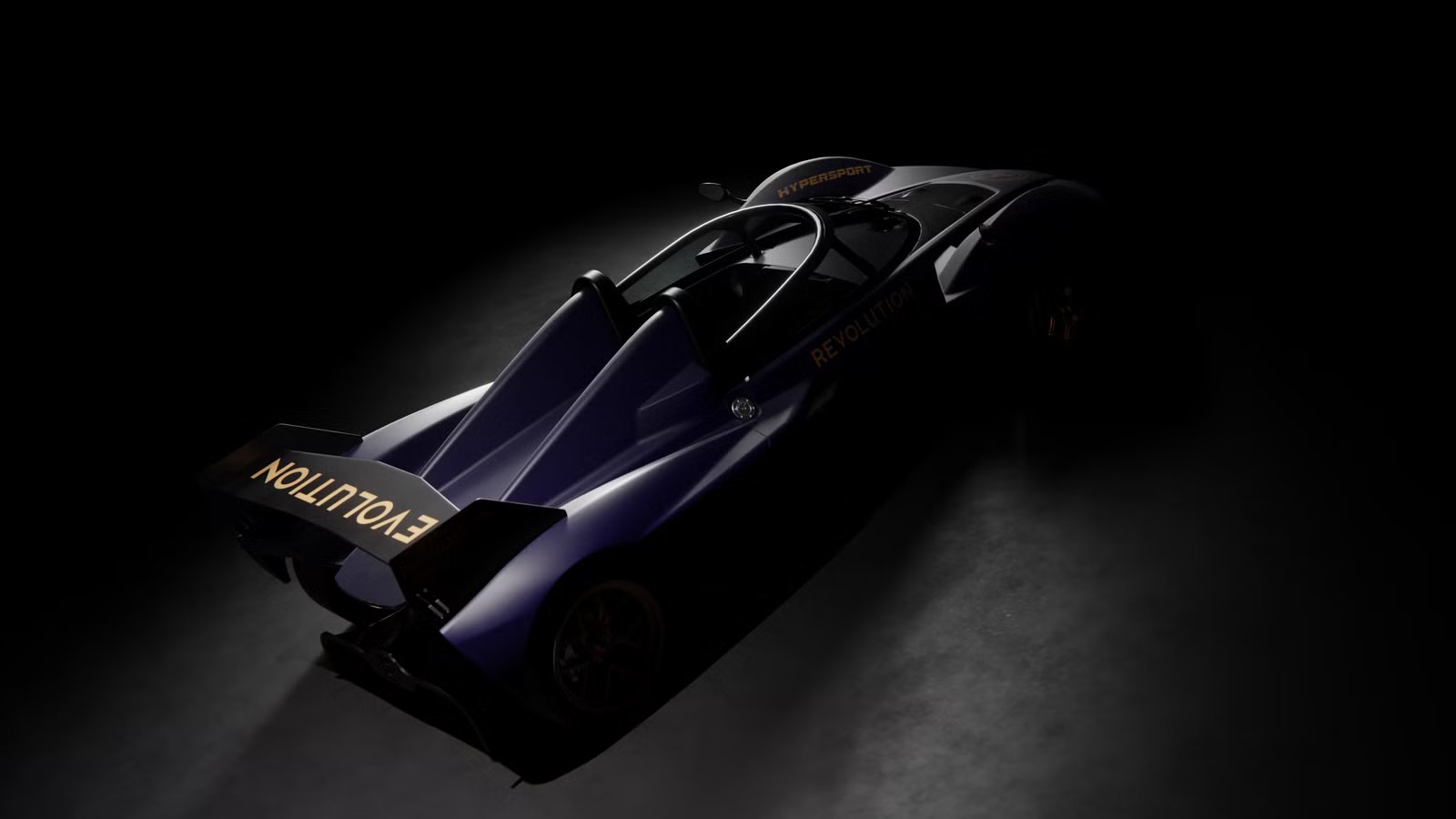
Revolution Race Cars is trying to carve out a new niche in the track-day world with the launch of the HyperSport. Described by the UK-based company as a lightweight track car built for performance and safety, the HyperSport combines the racing character of single-seaters, GTs, and prototypes.
Revolution has designed an all-new platform in the HyperSport that effectively creates its own segment in a unique market. By leveraging key technical lessons from the three aforementioned car styles, the HyperSport effectively merges them into one: the open-cockpit feel and agility of a single-seater, the safety of a GT car, and the high-downforce performance of a prototype.
Time and cost were among the other considerations for Revolution, as the company said it designed the car to provide elite-level performance without the operational complexity sometimes associated with top-tier racing.
“This has been achieved at a price point below $165,000, positioning the HyperSport as one of the most attainable entry points for racers or track day drivers to experience true high-end, prototype-level performance,” the company said in a statement.
Carbon-reinforced polymer chassis
New benchmark for the track
The HyperSport rides on a carbon-reinforced polymer chassis, developed in-house by Revolution. Historically, according to Revolution, this level of driver protection and torsional rigidity has been the domain of high-end carbon fiber builds, while more affordable track cars often rely on heavier tubular frames.
Revolution manages this balance by using vacuum resin infusion technology, the same process found on its flagship 500 EVO, for the construction of the chassis, bodywork, and critical safety components like the crash box. The result is a platform that offers the lightweight benefits of a conventional carbon fiber chassis without the typical prototype cost of entry.
Similar to how BMW’s purpose-built architectures are redefining electric vehicle performance, Revolution’s dedicated chassis aims to set a new benchmark for the track.
Related
I’m a racing instructor, and more horsepower doesn’t make cars more fun
Horsepower has become overrated.
Power-to-weight ratio
Special tire package
At the heart of the HyperSport is a 2.0-liter turbocharged engine tucked into a chassis that weighs a mere 1,543 lbs., resulting in a power-to-weight ratio of 430 bhp per metric ton. Revolution’s engineering team devised what they call a semi-ground-effect underfloor to keep downforce stable and predictable, even if the track surface isn’t perfect.
As described by Revolution, airflow is directed around the sides of the HyperSport and channeled through the underfloor from the front of the chassis, improving aerodynamic consistency while allowing a more comfortable driving position. This focus on efficiency mirrors how aerodynamics are redefining luxury in the consumer market, though here the goal is raw cornering speed rather than range.
To help with that, the HyperSport is standard with a 17-inch front and 18-inch rear tire package, a setup Revolution said is beneficial for drivers of all experience levels. Once again, this philosophy of using racing as a testbed is an ongoing trend, much like how Gazoo Racing influences upcoming engine designs for daily drivers.
Radar Band Detection
X, K, Ka
Companion App
Drive Smarter
The Escort MAX 360c MKII is the follow-up to the standard MAX 360c radar detector. This enhanced version features longer-range detection with its updated dual-antenna platform and enhanced false alert filtering through Blackfin DSP integration.
Tested to FIA standards
IndyCar-style aeroscreen
One of the standout features of the HyperSport is its safety tech, as the car is built around a carbon-reinforced polymer monocoque tested to FIA standards. At a price below $165,000, it’s currently the only car in its class to offer a full two-seat carbon-fiber chassis.
The cockpit also borrows from the world of open-wheel racing:
- Double Halo System: Provides a robust structural safety cage.
- IndyCar-Style Aeroscreen: Wraparound screen protects drivers and passengers while smoothing out airflow.
- Modular Design: The nose and engine cover are bolted assemblies, meaning if you have a mishap on track, you can swap out damaged sections rather than replacing entire body panels.
As noted by the modular design, the HyperSport was created with flexibility in mind. The cockpit can be swapped between center, left-hand, or right-hand drive positions depending on the owner’s preference. This makes it a practical tool for everything from solo runs to two-person driver coaching sessions.
The HyperSport is coming this summer
In the racing world, manufacturers like Revolution often create their own spec series, such as the Revolution Cup in the UK and USA. Owners race against identical cars, ensuring the focus is on driver skill rather than who has the biggest budget for upgrades. Events like this can serve as a competitive ladder for those who want to move up in the world of racing.
For the HyperSport, new classes will be integrated into existing prototype series across Europe and North America starting in 2027.
The new car itself is scheduled to be available this summer. Those who want to get an early start (i.e., VIP customers) will have the chance to participate in a race package at the Portimao F1 circuit in Portugal in late October 2026.
