

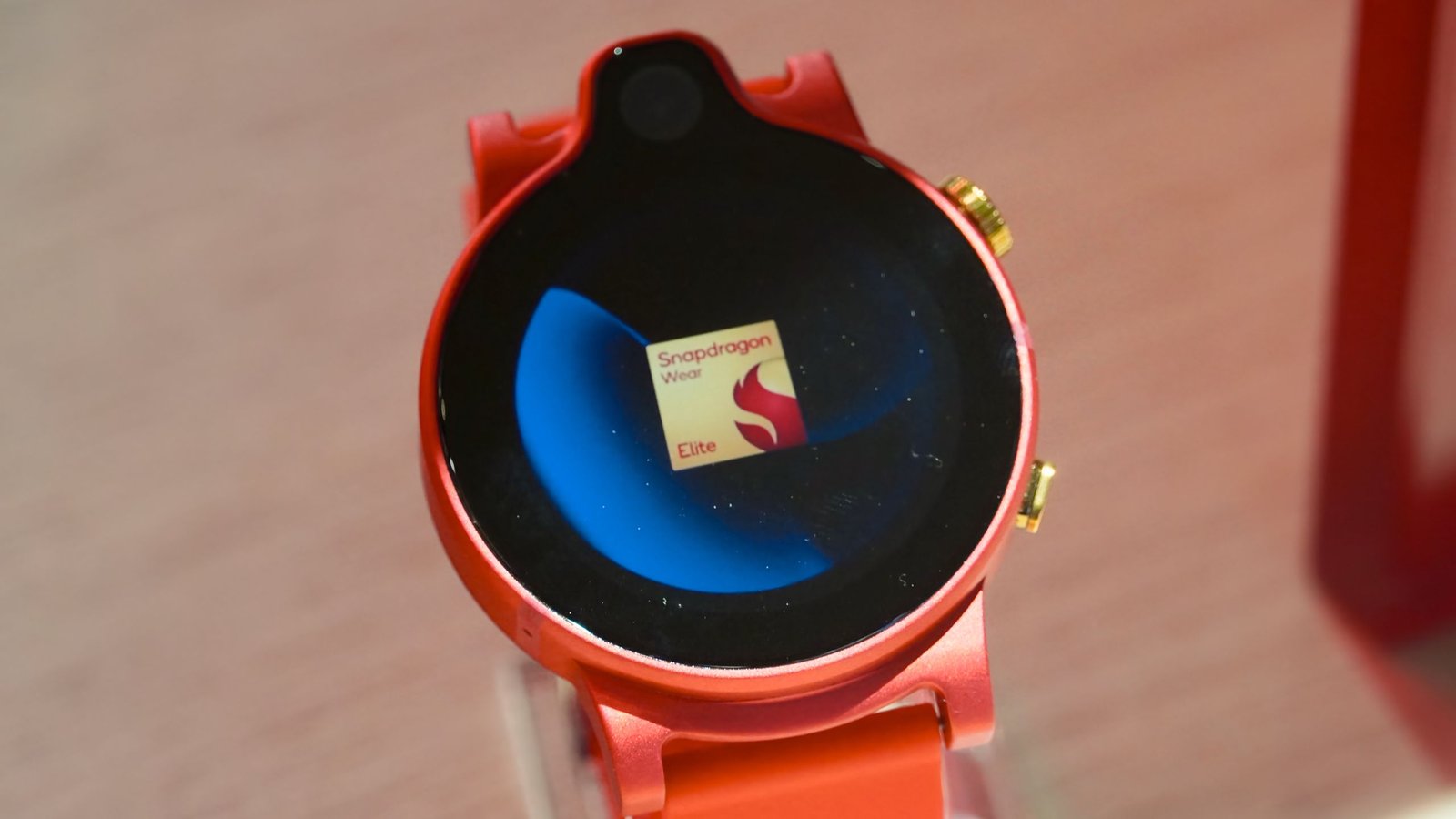
Qualcomm already brought Elite chips to smartphones, tablets, and laptops, and now they’re coming for your smartwatches. The company announced the new Snapdragon Wear Elite platform at MWC 2026, and it joins a wearable chip lineup that includes Snapdragon Sound, Snapdragon Wear, and Snapdragon AR. But what actually makes a smartwatch chipset “elite,” and do you really need “elite” performance from your next smartwatch?
I sat down with Ziad Asghar, the senior vice president of XR and spatial computing at Qualcomm, in a roundtable media session to find out. The answer is twofold. Even if you don’t use a bit of on-device AI, you’ll still benefit from Snapdragon Wear Elite’s improved performance and longer battery life. However, Qualcomm is betting that you will end up using new AI-powered features that weren’t previously possible on smartwatches.
You may like
Qualcomm provided travel, food, and lodging for my trip to MWC 2026, but had no input on my coverage and didn’t see this article before publishing.
AI can use face and object detection to control your devices in real time
(Image credit: Brady Snyder / Android Central)
The reference device for the Snapdragon Wear Elite chipset is a smartwatch with a camera, and it’s certainly a striking wearable. Of course, this is a proof-of-concept design that will never release, but there’s a reason a camera is onboard. It’s partly because Asghar says Qualcomm received feedback that some consumers want a camera on their smartwatch, such as to communicate with a child who may not have a phone. More importantly, it’s attributed to Wear Elite being used for personal AI wearables beyond smartwatches — like pendants, glasses, or pins — that need a camera for multimodal interaction.
A camera works with the AI models running locally on Snapdragon Wear Elite to power new features, like face and object detection. Asghar described a Wear Elite device using a local AI model to detect a face and moving a microphone beam towards that face to better pick up and isolate speech.
“I can, even in a very noisy environment, actually take in the sound and bring it from that source rather than from the 10 other sources that are creating ambient noise in the environment around it,” Asghar explained.
It’s also about picking and choosing which tasks to split between on-wearable processing, tethered smartphone processing, and cloud processing. A wearable could convert speech to text on-device and send only the text to a connected smartphone for processing. Then, once the processing is finished, the phone could send just the text to a wearable and let it handle text-to-speech conversion. “That’s how you’re able to get a very smooth, sort of operation,” Asghar said.
You’ll have more wearable form factors to pick from — or use them together
(Image credit: Brady Snyder / Android Central)
Snapdragon Wear Elite isn’t strictly a smartwatch chip — it’s designed for a multitude of wearable form factors. You could see pins, pendants, wristbands, and smartwatches powered by this chipset. Qualcomm sees AI becoming the center of your device ecosystem, with a bunch of different form factors working together to provide day-to-day experiences. It could expand the market, so if you don’t want to wear a smartwatch or glasses, you don’t have to.
That said, Asghar sees the exciting part as how these wearable form factors can work together to power features that wouldn’t work individually.
“I really think in the long run it might that actually you have more than one on each person,” Asghar said. “And depending on the use [case], they use the one or the other or both.”
For example, Asghar explained how a combination of smart glasses and a smartwatch as an alternative to smart display glasses. You could snap a picture on your smart glasses and immediately see the preview on your smartwatch. Or, if you don’t like those form factors, you could wear earbuds or a pendant with a camera. They all will work together, but also apart.
“I think this is going to be a really powerful part as to how you can combine the context across these devices, be able to aggregate that context, and I think that’s where a lot of the innovation is going to come,” Asghar explained. “So I do believe it’s going to be more than one of these devices in each person.”
Launching apps is faster, and you can run AI models on-device
(Image credit: Brady Snyder / Android Central)
If you don’t think you need AI on your smartwatch, there will be performance gains for non-AI use cases, too. The new architecture uses a five-core CPU with one 2.1GHz core and four cores at 1.95GHz, and it improves performance by up to 5x, with 7x faster graphics. This results in everything from launching apps to completing actions feeling snappier, according to Asghar.
This is the first smartwatch chip with a dedicated NPU, and this one can handle AI models up to two billion parameters. In the real world, this means that your smartwatch can process automatic speech recognition on-device, detect objects and faces, or generate text. There will surely be large language models (LLMs) that run on Wear Elite processors, but there will also be task-specific models aimed to deliver specific features.
In one demo video, a Snapdragon Wear Elite watch used on-device AI to generate a response to text messages using crucial context. It could adjust the tone and content of a suggested message based on who is texting and the previous conversation, so a text to your boss doesn’t sound like a text to your wife.
The on-device processing features could work using existing personalization tools like Gemini Personal Intelligence, or tap into awareness of what else your watch is doing. If you’re currently navigating to a destination in Maps, the smart replies feature could use that context to craft a suggested text message on your watch. These processes are handled by tiny, low-power eNPUs in the Wear Elite’s sensing hub or the dedicated Hexagon NPU.
You’ll get longer battery life thanks to new architectures
(Image credit: Brady Snyder / Android Central)
The eNPUs help other parts of the chip stay powered down, even when AI processing is required, which helps preserve battery life. The chipset offers up to 30% better battery life, so your smartwatch can either last longer or you can use it for more demanding features. The “sensing hub” in the Wear Elite platform is a big part of the efficiency gains, which are big enough for the average user to notice.
“You should think of the sensing hub as almost like a chip within a chip. And it’s one that we can run separately from the rest of the chip, which means the power consumption is very low. So, now you don’t have to wake up the full big part of the chip — all the different engines inside — and then run the NPU,” Asghar explained. “So, you will see huge power savings, especially because the agent gets invoked a lot in a smart glasses or personal AI device scenario.”
The switch to a 3nm process node also results in better battery life and efficiency. This is an upgrade over the Snapdragon W5 Plus Gen 2, which was a 4nm chip, and matches Samsung’s Exynos W1000 chip. The new architecture and custom IPs also help with efficiency, working behind the scenes to improve battery life.
When is Snapdragon Wear Elite actually launching for consumers?
(Image credit: Brady Snyder / Android Central)
Asghar says we can expect to see Snapdragon Wear Elite wearables — and their on-device AI features — sometime in the second half of this year. Samsung already announced that the next Galaxy Watch will be powered by Wear Elite, and Qualcomm is also working with Google and Motorola.
